



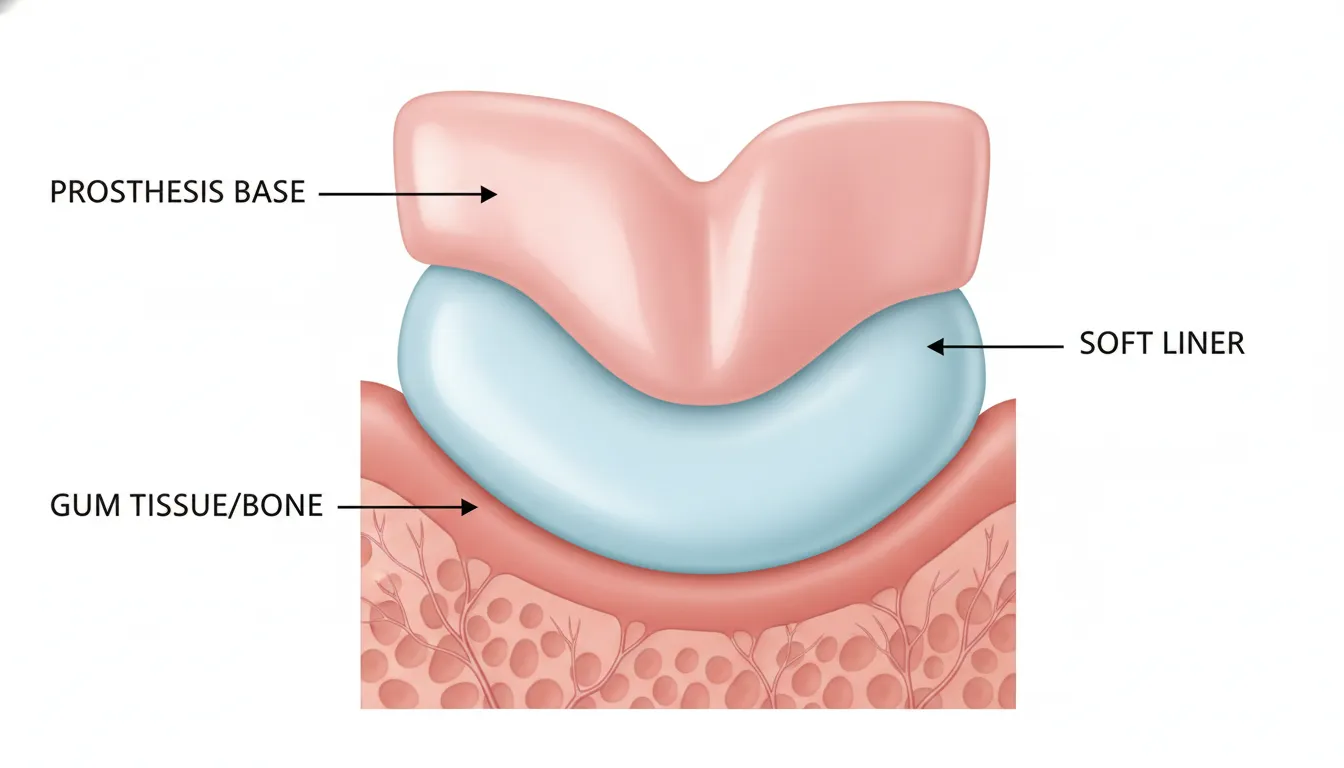
Denture liners are materials placed on the intaglio surface of a removable prosthesis to restore fit. Improve comfort, and redistribute occlusal forces as the residual ridge changes shape over time. These relining materials compensate for the bone resorption that follows tooth loss, bridging the gap between a stable denture base and the dynamic oral environment. Without proper liner selection, patients experience sore spots, reduced chewing efficiency, and accelerated bone loss from poor force distribution.
Schedule a free prosthetic consultation today. Call (480) 275-7144 to discuss how AvaDent digital denture technology can reduce your patients' dependence on frequent relines.
Denture liners are materials applied to the inner surface of a denture to improve fit, retention, and patient comfort as oral tissues change over time. The two main categories are plasticized acrylic resins (short-term, 3-6 month lifespan, strong bond) and silicone elastomers (long-term, 12-24 month lifespan, requires primer bonding). Selection depends on the patient's tissue condition, healing stage, and whether the reline is temporary or permanent. Modern digital denture workflows with monolithic PMMA construction reduce the dimensional changes that create the need for frequent relining.
Clinicians must understand how material chemistry, processing method, and patient-specific tissue conditions interact to choose the right denture base material for long-term clinical success. The wrong choice leads to premature hardening, bond failure, or patient discomfort. Below we examine the material science, clinical decision-making, and how digital fabrication is changing the reline paradigm.
What Are Denture Liners Made Of?
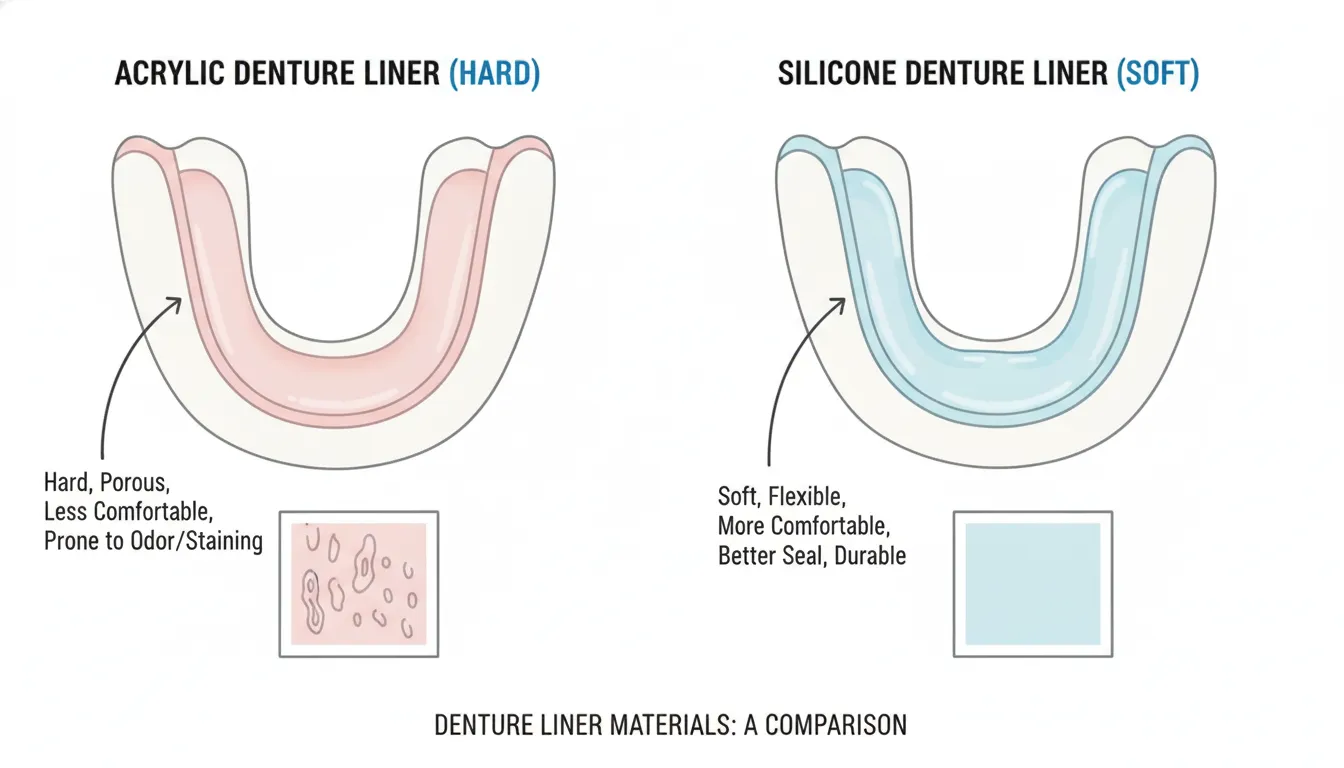
Denture liners fall into two distinct material families based on polymer chemistry: plasticized acrylic resins and silicone elastomers. Each family has characteristic advantages in softness, longevity, bond strength, and clinical workflow.
Key differences between the two material types:
- Acrylic resins: Contain monomer liquid with dissolved plasticizers (ethyl alcohol) mixed with polymer powder. Initial softness is high, but plasticizers leach into oral fluids over 3-6 months, causing the liner to harden and lose cushioning.
- Silicone elastomers: Cross-linked polydimethylsiloxane polymers with no leachable plasticizers. Maintain resilience for 12-24 months. Require primer application for bonding to the PMMA denture base.
- Bond mechanism: Acrylic forms a chemical bond with the existing acrylic base during curing. Silicone relies on mechanical interlock via silane primers and is more prone to peel failure at the liner-base interface.
- Porosity: Both materials are porous relative to hard denture acrylic, but silicone exhibits slightly higher fluid absorption over long-term use.
Material Categories and Composition
Plasticized acrylic resins are the most widely used short-term reline materials. Brands such as Coe Soft and Coe Comfort are chairside-applied, curing intraorally within minutes. The liquid monomer contains plasticizing agents like ethyl alcohol or butyl phthalyl butyl glycolate that lower the glass transition temperature of the polymer. Creating a gel-like consistency at oral temperature. The plasticizer molecules are not chemically bound to the polymer matrix and slowly leach into saliva. Once the plasticizer concentration drops below the threshold needed for chain mobility, the material becomes rigid and brittle, typically within 90 to 180 days.
Silicone elastomers use a different polymer architecture. Cross-linked polydimethylsiloxane chains achieve their softness through the inherent flexibility of the siloxane backbone, not through additive plasticizers. This eliminates the leaching failure mechanism entirely. However, silicone lacks the polar functional groups needed for direct chemical bonding to PMMA. Clinicians must apply a primer layer that contains adhesive promoters such as methacrylate-functionalized silanes. The primer creates a chemical bridge between the silicone network and the denture base. Even with proper primers, the silicone-base interface remains the weakest point in the restoration.
Laboratory vs. Chairside Processing
Chairside relines use auto-polymerizing acrylics or silicone materials that set at oral temperature within 5-15 minutes. The advantages are speed and convenience. The trade-offs include lower cross-link density, more residual monomer, and a less durable bond. Laboratory-processed relines undergo heat curing under controlled temperature and pressure, typically at 74 degrees C for 8-12 hours depending on the material system. Heat curing drives monomer conversion rates above 95 percent, minimizes leachable residual components. And produces a denser polymer network that resists staining and bacterial colonization more effectively than chairside alternatives. For permanent soft liners intended to last 12 months or more, laboratory processing is the standard of care.
What Are the Clinical Trade-Offs Between Acrylic and Silicone Denture Liners?
When choosing between acrylic and silicone denture liners, clinicians must weigh initial softness against long-term durability, bond strength against replacement frequency, and chairside convenience against laboratory precision. Each material excels in a different clinical scenario.
| Property | Acrylic Liners | Silicone Liners |
|---|---|---|
| Initial Softness | Higher | Moderate |
| Bond Strength | Excellent (chemical bond) | Requires primer (mechanical) |
| Longevity | 3-6 Months | 12-24 Months |
| Ease of Application | Easy (Chairside) | Laboratory Processed |
| Maintenance | High (7-10 Day Refills) | Minimal |
| Relative Cost | Lower | Higher |
| Hardening Mechanism | Plasticizer leaching | Bond fatigue / peel |
The most common failure mode for soft liners is debonding at the liner-base interface. Acrylic liners fail by hardening, while silicone liners fail by peeling. Both failure types require digital denture reline protocols to restore proper fit without compromising the prosthesis structure. Understanding these trade-offs allows clinicians to match material selection to the specific demands of each case.
- When to choose acrylic: Post-extraction healing phase, immediate denture patients, short-term tissue conditioning, cases requiring frequent reapplication.
- When to choose silicone: Patients with thin atrophic mucosa, bony undercuts, xerostomia, implant-supported overdentures during osseointegration, cases where long-term resilience is required.
- When to choose laboratory processing: Permanent soft liners, patients with poor oral hygiene (denser material resists staining), high parafunctional forces that stress the liner bond.
How to Select the Right Denture Liner for Each Patient
Patient-specific factors determine whether a temporary soft liner, permanent soft liner, or hard reline is clinically appropriate. The selection algorithm depends on healing stage, tissue quality, and the patient's ability to maintain oral hygiene.
Liners for Immediate and Healing Phases
After extraction, the alveolar ridge undergoes rapid resorption during the first three to six months. Patients with immediate dentures placed on extraction day need temporary soft liners that can be refreshed every 7-10 days to maintain fit as the ridge shrinks. Chairside acrylic liners are preferred here because of their easy reversibility, low cost, and ability to be added incrementally. During this phase, the primary goal is not durability but the ability to adapt quickly to a changing tissue profile.
Addressing Thin Tissues and Bony Undercuts
Patients with severe ridge resorption present a particular challenge. Their mucosa lacks the submucosal connective tissue layer that provides natural cushioning under a rigid denture base. Soft silicone liners act as a shock-absorbing layer that distributes occlusal forces across a wider surface area, reducing localized pressure points. For patients with sharp mylohyoid ridges or prominent tori that create bony undercuts, a soft liner following denture protocols for severe ridge resorption allows the prosthesis to engage these contours without causing mucosal ulceration.
Complex Cases: Xerostomia and Implant Sites
Xerostomia patients lose the protective salivary layer that normally lubricates the denture-tissue interface. Their mucosa becomes friable and prone to frictional abrasion. Soft liners reduce shear forces on the compromised epithelium. Clinicians managing these patients should follow dry mouth denture care protocols that include silicone-based liners for their longer service life and lower fluid absorption.
Implant-supported overdentures during the osseointegration phase also benefit from soft liners. The liner prevents direct occlusal load transfer to the healing implant sites while providing enough retention for the patient to function. Once osseointegration is confirmed, the transition to a definitive hard reline or a new digitally fabricated prosthesis completes the treatment sequence. For clinicians managing implant cases, the AvaMax implant-supported denture guide provides a structured protocol for the transition from healing to definitive restoration.
Professional Relining vs. DIY Kits
Patients may be tempted to use over-the-counter reline kits when their dentures feel loose. These products use low-quality auto-polymerizing materials that cannot form adequate bonds with the denture base. The long-term consequences include microbial colonization between the liner and the base. Accelerated bone resorption from uneven pressure distribution, and bite misalignment as the material sets in the wrong vertical dimension. Professional soft relines use high-quality silicone or heat-cured acrylic materials, ensure the bite remains correctly recorded. And allow the clinician to perform an oral cancer screening during the appointment. Denture hygiene recall scheduling should include regular reline assessment at six-month intervals for patients with soft liners.
Can Digital Denture Technology Reduce Dependence on Denture Liners?
While denture liners manage the consequences of an ill-fitting prosthesis, digital denture fabrication addresses the root cause: dimensional inaccuracy in the denture base. Modern CAD/CAM workflows produce restorations that hold their fit longer, reducing the frequency and intensity of reline interventions.
Strong Monolithic Design
AvaDent monolithic XCL dentures are milled from a single block of pre-shrunk, high-density PMMA. This manufacturing method eliminates the polymerization shrinkage that plagues conventional heat-cured and pour-type resins. Traditional acrylic shrinks approximately 0.5-0.8 percent linearly during curing, which translates to a clinically significant gap at the denture-tissue interface. Pre-shrunk pucks cannot shrink again after milling, so the delivered prosthesis matches the digital design within 25 microns. The monolithic construction also eliminates the tooth-base interface, making the denture up to 8x stronger than hand-fabricated equivalents. This allows thinner flanges (1.5 mm vs. 2.0 mm for 3D-printed alternatives) without compromising structural integrity.
The clinical consequence is a prosthesis that maintains its adaptation to the digital denture design specifications for years rather than months. Patients who receive monolithic digital dentures often require no immediate reline and do not need their first soft liner until the ridge undergoes significant long-term resorption events many years later.
Fewer Adjustments and Better Hygiene
Digital workflows reduce the need for soft liners through better initial fit and more durable materials. Adaptive Occlusion tools can reduce denture adjustment visits by up to 98 percent by automatically optimizing the occlusal scheme during the design phase. When the occlusal contacts are balanced from day one, there are fewer pressure points that would otherwise require soft liner cushioning to manage.
Material density also plays a role in liner dependence. High-density PMMA blocks are milled with virtually no porosity, unlike conventional acrylic that contains microscopic air voids where moisture and bacteria accumulate. A non-porous denture base resists staining and bacterial adhesion, maintaining a cleaner oral environment that helps the underlying tissue stay healthy. For patients who do eventually need a reline, the stored digital file means the laboratory can produce an exact replica without new impressions. This denture adjustment reduction approach saves chair time and produces a more predictable outcome than manual reline procedures.
Ready to reduce chair time and improve outcomes for your denture patients? Call (480) 275-7144 to schedule a free prosthetic consultation with the AvaDent team.
Frequently Asked Questions
How often should denture liners be replaced?
Replacement intervals depend entirely on the material type and the patient's tissue changes. Temporary acrylic soft liners used during the post-extraction healing phase need refreshing every 7 to 10 days. Plasticized acrylic permanent liners typically harden within 3 to 6 months as plasticizers leach out. Silicone elastomers can remain functional for 12 to 24 months before significant bond fatigue or material degradation occurs. Laboratory-processed heat-cured liners offer the longest service life among soft liner options.
Can digital dentures replace the need for relines entirely?
Digital dentures cannot stop the natural bone resorption that occurs after tooth loss, so some patients will eventually need a reline or replacement regardless of fabrication method. However, the precision of monolithic CAD/CAM fabrication significantly delays the onset of fit problems. Because pre-shrunk PMMA blocks eliminate dimensional changes, the initial fit is more accurate and stays accurate longer than conventionally processed dentures. Patients often go several years before needing their first reline, compared to months with traditional fabrication.
What is the difference between a hard reline and a soft reline?
A hard reline uses rigid auto-polymerizing or heat-cured acrylic to restore the denture base fit when the underlying ridge is healthy and stable. Hard relines are permanent and do not need periodic replacement unless the ridge changes. A soft reline uses resilient materials (acrylic or silicone) to cushion the denture-tissue interface for patients with sensitive mucosa, thin tissue, bony undercuts, or healing surgical sites. Soft relines require periodic replacement because the material degrades over time through plasticizer loss (acrylic) or bond fatigue (silicone).
How should patients clean denture liners at home?
Patients should use a soft-bristle brush and non-abrasive cleanser specifically designed for soft liner materials. Hard-bristle brushes and abrasive toothpastes abrade the liner surface, creating rough areas that harbor bacteria and accelerate material breakdown. Denture cleaning tablets without bleach are acceptable for soft liners. Patients should avoid isopropyl alcohol, bleach solutions, and hot water, all of which degrade the liner polymer and weaken the bond to the denture base. Professional ultrasonic cleaning at recall appointments helps maintain liner hygiene and extends service life.
Ready to schedule a free prosthetic consultation?
Relying on manual reline cycles costs your practice chair time and frustrates patients who need frequent adjustments. Each reline appointment consumes resources that could be redirected toward new case starts. While patients who experience repeated fit problems may lose confidence in their prosthesis and your treatment recommendations. Monolithic digital dentures from AvaDent eliminate the dimensional variability that drives the reline cycle, giving your patients a restoration that fits from insertion through the long term. Digital records stored in the patient file mean replacement prostheses can be fabricated from the approved design file without new impressions or chairside reline procedures.
Ready to schedule a free prosthetic consultation? Call (480) 275-7144 to set up your case review and start your first digital case.