



AvaMax Implant-Supported Dentures: Complete Guide for Prosthodontists
Implant-supported dentures have long offered edentulous patients superior stability and function compared to conventional tissue-retained prosthetics. But until recently, the prosthetic component itself remained a limiting factor - conventional overdenture materials fracture under load, accumulate bacteria at bonded interfaces, and demand repeated chairside adjustments that erode practice profitability. AvaMax dentures from AvaDent Digital Dental Solutions change that calculus entirely. By integrating a 3D-printed titanium framework directly into a precision-milled, eXtreme-Cross-Linked (XCL) PMMA monolith, AvaMax delivers titanium-reinforced dentures engineered to handle the biomechanical demands of implant retention - while virtually eliminating adjustment appointments.
Contact AvaDent to discuss AvaMax implant-supported dentures for your next prosthodontic case.
This guide covers what prosthodontists need to know: the technology behind AvaMax, clinical indications, how it compares to standard overdentures, the All-on-4 and All-on-6 connection workflow, Adaptive Occlusion integration, and validated material strength data.
What Is AvaMax? Understanding the Titanium Framework Integration Technology
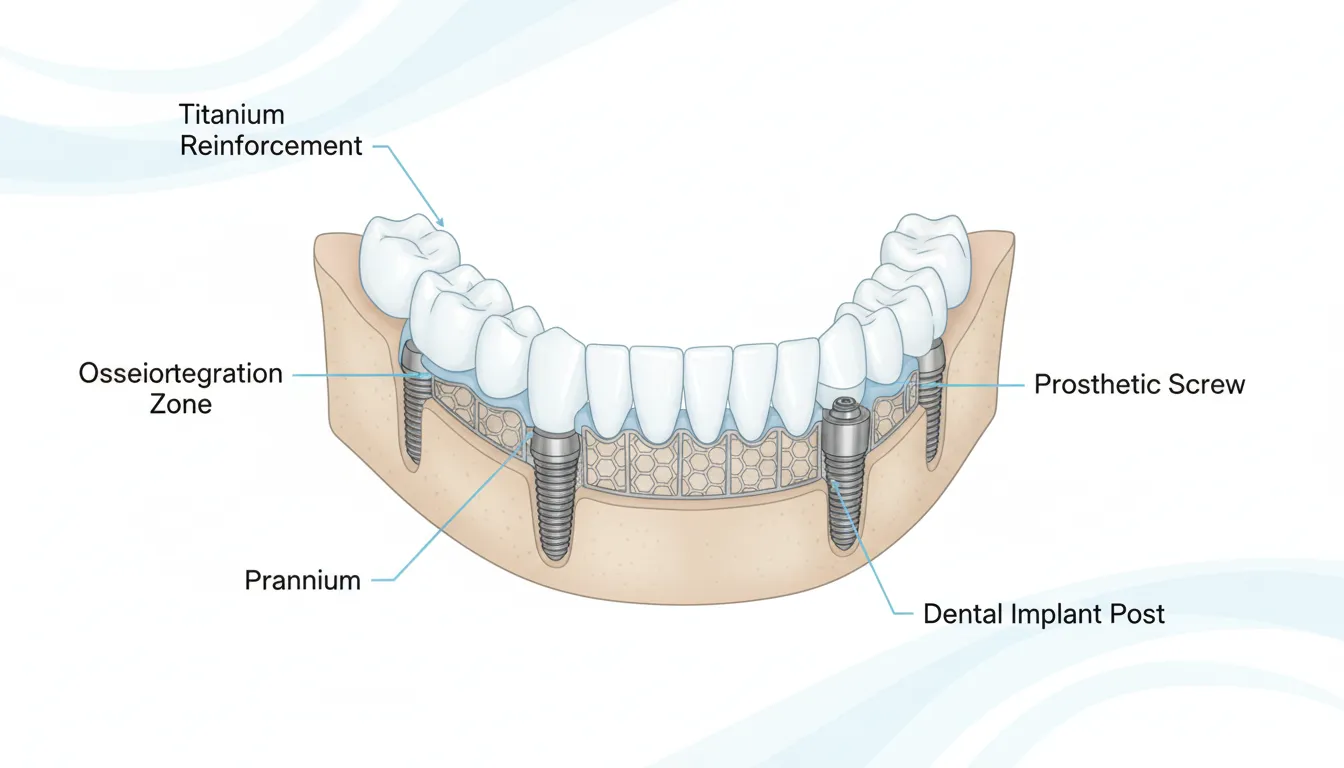
AvaMax is AvaDent's premium implant prosthetic line built on a patented hybrid manufacturing process that permanently bonds a 3D-printed titanium lattice core inside a precision-milled XCL PMMA monolith - producing a titanium-reinforced denture up to 8 times stronger than conventional acrylic, with no delamination risk and a virtually porosity-free surface that resists bacterial colonization.
The process begins with a 3D-printed titanium core featuring a honeycomb lattice (space-truss) architecture. High-pressure XCL acrylic is compression-molded over and through the titanium lattice as a single piece, penetrating the open structure to form a permanent chemical and mechanical bond. There is no bonding interface to fail. The monolith is then CNC-milled for final occlusal anatomy and implant connections.
The result is a prosthetic that delivers:
- Rigid, fracture-resistant backbone - the titanium lattice distributes biting forces across the entire arch, not just at implant contact points
- No delamination - the permanent chemical bond between titanium and PMMA eliminates the delamination risk present in bar-retained systems with acrylic overlays
- Lightweight design - approximately 3.5 times lighter than full-arch zirconia alternatives, reducing implant loading and improving patient comfort
- Virtually porosity-free surfaces - high-pressure milling eliminates the microscopic voids that harbor Candida albicans and other oral pathogens in conventional acrylics
- Ultra-low residual monomer content - pre-polymerized XCL blocks contain near-zero residual monomer, eliminating the plasticizer effect that degrades strength in conventional heat-cured acrylics
AvaMax is available in four configurations: the AvaMax Bio-Hygienic Denture (titanium-reinforced complete denture for high-force patients), the AvaMax Overdenture (implant-retained with pre-milled pockets), the AvaMax Hybrid Denture (screw-retained fixed full-arch), and the AvaMax LOCATOR FIXED® (fixed prosthesis using ZEST LOCATOR abutments). This guide focuses primarily on the overdenture and hybrid configurations most relevant to implant-retained full-arch reconstruction. For a full overview of the newest types of digital dentures, including where AvaMax fits in the broader prosthetic landscape, see AvaDent's clinical resource library.
Which Patients Are the Best Candidates for AvaMax Implant-Supported Prosthetics?
AvaMax is indicated specifically for cases where standard acrylic overdentures are likely to underperform biomechanically or hygienically - not as a universal replacement for conventional prosthetics, but as a precision tool for the patient populations and clinical scenarios where titanium reinforcement delivers measurably better outcomes.
Primary Indications
- High occlusal load patients - bruxers, clenchers, and patients with strong bite forces who fracture conventional acrylic overdentures. The titanium lattice absorbs and redistributes these forces in a way acrylic alone cannot.
- Full-arch implant cases (All-on-4 / All-on-6) - where a screw-retained fixed prosthesis is planned and the practice wants to avoid the cost and opacity of full-arch zirconia.
- Open-palate overdenture requirements - patients with strong gag reflexes or those transitioning from upper dentures. The titanium core provides enough structural integrity to eliminate the palatal coverage that acrylic overdentures typically require for strength.
- Patients with prosthetic stomatitis history - the virtually porosity-free XCL surface resists bacterial and fungal colonization, a clinically meaningful advantage for patients with recurrent denture stomatitis at risk of tissue breakdown under conventional acrylic prosthetics.
- Complex implant topographies - the AvaMax Overdenture features pre-milled implant pockets with a titanium "basket" structure over each pocket, preserving prosthetic strength at the most structurally vulnerable points while maintaining passive fit.
Relative Indications (Case-by-Case Basis)
- Patients transitioning from bar-retained overdentures who have experienced repeated acrylic fractures
- Prosthodontic cases where an open-palate maxillary overdenture is aesthetically preferred
- DSO-managed patients requiring standardized, reproducible outcomes with minimal variance across providers
AvaMax vs. Standard Overdentures: A Material Strength Comparison
AvaMax implant-supported prosthetics outperform conventional acrylic overdentures across every clinically relevant dimension: flexural strength (up to 8 times higher), fracture resistance at implant pockets, bacterial resistance, and weight - while costing approximately 3.5 times less in structural mass than full-arch zirconia alternatives that carry equivalent mechanical demands.
Implant-supported prosthetics experience biting forces of 50-150 N in posterior regions - forces that often exceed the fatigue threshold of unreinforced PMMA over time, particularly at implant pocket margins where stress concentration is highest. The comparison below reflects validated clinical data from 20+ peer-reviewed studies spanning 2015-2024.
| Property | Conventional Acrylic Overdenture | AvaMax Overdenture (XCL + Ti) |
|---|---|---|
| Flexural strength | Baseline | Up to 8x higher than conventionally fabricated dentures |
| Fracture risk at implant pockets | Moderate-high with heavy loading | Significantly reduced - Ti basket structure reinforces each pocket |
| Delamination risk | N/A (no framework) | None - permanent chemical + mechanical Ti/PMMA bond |
| Surface porosity | Present - conventional acrylic is porous | Virtually zero - pre-polymerized under high pressure |
| Bacterial colonization | Higher susceptibility | Significantly reduced - non-porous XCL surface |
| Weight vs. zirconia alternative | Similar or heavier | ~3.5x lighter than full-arch zirconia |
| Open-palate feasibility | Limited (requires palatal coverage for strength) | Possible - Ti core provides sufficient rigidity |
| Repairability | Yes | Yes - unlike zirconia, AvaMax can be repaired chairside or in-lab |
Understanding fixed vs. removable full-arch prosthetic options is the upstream clinical decision that AvaMax helps resolve - its strength profile makes it viable for both categories in a way that conventional acrylic cannot match.
How Does the All-on-4 and All-on-6 Connection Process Work with AvaMax?
The AvaMax Hybrid Denture and AvaMax LOCATOR FIXED® are purpose-built for full-arch implant reconstruction, with a five-step digital workflow that covers everything from scan to verified delivery - eliminating the manual laboratory steps that introduce variability and add appointments in conventional full-arch protocols.
Step 1: Digital Planning and Record Capture
After implant osseointegration, the restorative workflow begins with digital record capture using intraoral scanning. AvaDent's platform integrates with all major systems, including iTero, 3Shape TRIOS, Medit, and Planmeca. The clinician scans the implant-level impression copings (scan bodies) in maximum intercuspation, captures a bite record, and uploads to the AvaDent Dashboard. A desktop scan of conventional impression models is also accepted.
Step 2: Prosthetic Design and Digital Preview
AvaDent's CAE (Computer Aided Engineering) platform generates the prosthetic design within 1-2 business days. For AvaMax Hybrid cases, the Ti-bar framework is digitally designed after the prosthetic tooth arrangement is finalized - ensuring the framework optimizes structural support for the specific occlusal scheme, not the other way around. A full-color digital preview (Bouma Try-In option) is available before fabrication is confirmed.
Step 3: AvaMax Fabrication
Once the design is approved, AvaDent's dual-facility manufacturing process (Scottsdale, AZ and Tilburg, Netherlands) produces the AvaMax prosthetic in 11-12 business days total. The Ti-bar is 3D-printed, the XCL PMMA is molded over and through the lattice under high pressure, and CNC milling finalizes the occlusal surface and implant connection geometry simultaneously - ensuring implant connection accuracy is not degraded by downstream milling steps.
Step 4: Delivery and Seating
For screw-retained AvaMax Hybrid cases, the prosthetic is delivered with access channels pre-milled to the correct angulation for each implant. For AvaMax LOCATOR FIXED® cases, LOCATOR abutments eliminate screw-access channel esthetics while maintaining fixed-prosthesis stability. Adaptive Occlusion technology minimizes chairside occlusal adjustments at this appointment - historically the most time-consuming step in full-arch delivery.
Step 5: Verification and Records
Every AvaMax prosthetic is 3D-scanned and digitally compared to the original design file before shipping. Digital records are stored permanently on the AvaDent platform, enabling exact reproduction if the prosthetic is lost, damaged, or requires a backup - a significant advantage over conventional full-arch restorations that require complete re-impression. For detailed submission protocols, see AvaDent's AvaMax Clinical Record Procedures and the AvaMax Hybrid Screw-Retained Fixed Digital Technique workflow guide.
Clinical Workflow Differences vs. Conventional Overdentures
Transitioning from conventional overdenture fabrication to AvaMax digital prosthetics reduces total appointment count from 5-7 visits to 2-4, replaces wax try-ins with a full-color digital preview, and eliminates the 24-hour and 1-week adjustment appointments that conventional overdenture delivery requires - all without sacrificing clinical precision.
Impression and Record Phase
Conventional overdenture: Requires primary impressions in stock trays, custom tray fabrication, final impressions with border molding, jaw relation records, wax rim try-in, tooth arrangement try-in, and final delivery. Total appointment count: typically 5-7 visits, 30-60 minutes each.
AvaMax digital workflow: Intraoral scanning or conventional impressions are submitted directly to AvaDent's Dashboard. No custom tray fabrication is required. A digital try-in (Bouma Try-In) replaces the wax rim and tooth arrangement appointments. Total appointments: 3-4 visits, typically 30 minutes each. For straightforward cases, the Reference Denture protocol can reduce this to 2 appointments.
Try-In Phase
Conventional overdenture: Wax rim try-in for VDO and centric relation, followed by separate tooth arrangement try-in in wax - each requiring laboratory return cycles between appointments.
AvaMax digital workflow: The Bouma Try-In is a full-color printed or milled representation of the final prosthetic design, including tooth shade and gingival morphology. It provides a complete esthetic and functional preview in a single appointment, with any modifications digitally incorporated before final fabrication. No laboratory wax rims or hand-set tooth arrangements are involved.
Delivery Phase
Conventional overdenture: Insertion typically requires significant occlusal adjustment, pressure-point identification with PIP or articulating paper, and multiple selective adjustments. Adjustment appointments at 24 hours, 1 week, and 1 month are standard protocol.
AvaMax digital workflow: Adaptive Occlusion software pre-calculates occlusal contacts using 70 billion data points, virtually eliminating adjustment appointments. AvaDent's clinical data shows a 98% reduction in adjustment appointments for AvaMax Overdenture cases. Delivery appointments typically complete in 30 minutes or less.
Long-Term Management
Conventional overdenture: Subject to tissue change-driven relining needs; fracture at implant pockets is common in high-force patients; replacement requires full re-impression.
AvaMax digital workflow: XCL material resists deformation from tissue changes better than conventional acrylic; titanium reinforcement prevents fracture at implant pockets; replacement prosthetics can be fabricated from digital records without new clinical records in most cases.
Full documentation of all AvaDent clinical workflows, including the AvaMax overdenture protocol, is available on the AvaDent Protocols page.
How Does Adaptive Occlusion Work in AvaMax Prosthetics?
Adaptive Occlusion is AvaDent's proprietary AI-powered occlusal engineering software, fully integrated into every AvaMax fabrication. It models dynamic articulation for each patient using over 70 billion occlusal data points - pre-calculating and incorporating contact geometry directly into the milled prosthetic so the final prosthetic arrives in functional occlusion for the vast majority of cases, with no adjustment appointment needed.
For each new AvaMax prosthetic, the algorithm:
- Analyzes the specific jaw relation records submitted for the case
- Models dynamic articulation paths (not just centric occlusion) based on population-level movement patterns correlated to the patient's anatomical parameters
- Pre-adjusts cuspal anatomy and contact points to account for the functional envelope the patient will generate in use
- Outputs a milling path that incorporates these dynamic occlusal adjustments into the final prosthetic geometry
For practices performing high volumes of full-arch implant restorations, this translates directly to chair-time savings and patient satisfaction improvements at the delivery appointment - historically one of the most technically demanding and time-variable steps in the workflow. Adaptive Occlusion is also integrated with AvaDent's Signature Teeth technology and Digital Positioning Technology, which use AI to optimize tooth morphology and positioning for each patient's arch form, further reducing the need for chairside esthetic modifications at delivery. For a broader look at how denture materials and digital fabrication interact in outcomes, AvaDent's clinical resources cover the full materials science landscape.
Why AvaMax Belongs in the Prosthodontist's Protocol
AvaMax implant-supported prosthetics are the clinically validated choice for full-arch implant cases where conventional acrylic overdentures would compromise outcomes - delivering titanium-reinforced durability, virtually porosity-free hygiene performance, and digital-workflow precision across high-force patients, open-palate designs, hygiene-critical cases, and practices that need consistent, low-adjustment delivery appointments.
- Durability: XCL + titanium reinforcement produces flexural strength up to 8x that of conventional dentures, with zero delamination risk and resistance to implant-pocket fracture
- Esthetics: Natural tooth translucency from XCL-2 polychromatic material - superior to the opacity of full-arch zirconia - with Signature Teeth morphology optimized per arch form
- Workflow efficiency: Adaptive Occlusion eliminates 98% of adjustment appointments; full digital records enable replacement fabrication without new impressions
- Hygiene: Virtually porosity-free surfaces reduce bacterial colonization risk for the life of the prosthetic
- Value: Approximately 3.5x lighter and more cost-effective than full-arch zirconia, with equivalent or superior functional outcomes in most cases
Frequently Asked Questions About AvaMax Implant-Supported Dentures
How do AvaMax implant-supported dentures differ from standard acrylic overdentures?
AvaMax dentures incorporate a 3D-printed titanium lattice core permanently bonded within the XCL PMMA monolith, creating a hybrid prosthetic that is up to 8 times stronger than conventionally fabricated acrylic overdentures. Standard acrylic overdentures rely on unreinforced PMMA, which is susceptible to fracture at implant pockets under high loading conditions and has a porous surface that can harbor bacteria. AvaMax eliminates both limitations through titanium reinforcement and a virtually porosity-free XCL material surface.
Is AvaMax compatible with All-on-4 and All-on-6 implant protocols?
Yes. The AvaMax Hybrid Denture (screw-retained fixed) and AvaMax LOCATOR FIXED are specifically designed for full-arch implant reconstruction, including All-on-4 and All-on-6 protocols. The titanium bar framework is digitally engineered to match the specific implant topology, and CNC milling finalizes the implant connection geometry simultaneously with occlusal anatomy to ensure passive fit and accurate emergence profiles.
What is Adaptive Occlusion and how does it benefit implant prosthetic delivery?
Adaptive Occlusion is AvaDent's proprietary AI-powered software that models dynamic articulation for each patient using over 70 billion occlusal data points. It pre-calculates and incorporates occlusal contacts into the milled prosthetic geometry, so the final AvaMax arrives in functional occlusion for the vast majority of cases. Clinical data shows this eliminates 98% of adjustment appointments compared to conventional overdenture delivery.
Can AvaMax overdentures be fabricated without palatal coverage?
Yes. The titanium core in AvaMax Overdentures provides sufficient structural rigidity to enable open-palate maxillary designs - a configuration that is difficult or impossible to achieve safely with unreinforced acrylic overdentures. Open-palate AvaMax prosthetics are a particularly good option for patients with strong gag reflexes or those who find full palatal coverage uncomfortable.
What is the turnaround time for AvaMax implant-supported prosthetics?
AvaMax prosthetics have a total turnaround time of 11-12 business days from design approval to delivery: 1-2 business days for design and digital preview, and approximately 10 business days for manufacturing and shipping. AvaDent includes free 2-day FedEx shipping, with rush options available. Standard AvaDent digital dentures without AvaMax titanium reinforcement ship in 7-8 business days.