




Centric Relation for Dentures
Centric relation for dentures is not simply a bite registration; it is a reproducible maxillomandibular reference that helps the clinician, technician, and digital design team establish an occlusion that can be evaluated consistently. When record bases move, vertical dimension is uncertain, or the mandibular position cannot be repeated, even an accurate scan can transfer an inaccurate relationship. A disciplined protocol therefore focuses on patient readiness, stable records, guided closure, verification, and precise laboratory communication.
Review the clinical records required for an AvaDent case
Why Centric Relation Matters in Complete Denture Treatment
For an edentulous patient, the clinician cannot use natural tooth intercuspation as a stable reference. Centric relation provides a clinically useful position for organizing the prosthetic occlusion independently of tooth contact. Its value is practical: it gives the restorative team a repeatable reference from which tooth arrangement, occlusal contacts, and excursions can be assessed.
A record is useful only when it can be repeated. A single closure that appears acceptable does not establish reliability. The clinician should be able to guide the patient into the same position several times, observe consistent contact between the rims or registration stops, and confirm that the bases remain seated. If repeated closures produce different endpoints, the cause should be investigated before the relationship is transferred.
Centric relation and maximum intercuspation are different references
Centric relation describes a maxillomandibular relationship. Maximum intercuspation describes the position of greatest tooth contact. In a new complete denture case, maximum intercuspation is created during prosthetic design; it is not an existing reference that can guide treatment. Conflating the two can conceal a slide, an unstable record, or an occlusal arrangement that directs the mandible away from the intended position.
The record influences more than occlusal contacts
A dependable jaw relation supports decisions about tooth position, esthetics, phonetics, restorative space, and the planned occlusal scheme. An inconsistent record can result in substantial correction at try-in or delivery. It may also make it difficult to distinguish a true jaw-relation discrepancy from base movement, premature contact, or an error introduced during mounting or digital articulation.
Centric relation should therefore be treated as one component of a coordinated clinical dataset. The record must be interpreted alongside the selected vertical dimension, midline, smile line, lip support, occlusal plane, ridge anatomy, and any patient-specific functional considerations.
Prepare the Patient and Records Before Registration
Reliable registration begins before material is placed between the rims. The appointment should provide enough time to assess the tissues, establish stable record bases, refine rim contours, and coach the patient. Trying to capture a relationship before these prerequisites are controlled often creates a record that looks precise but does not represent a repeatable mandibular position.
Assess the clinical conditions
Review the residual ridges, mucosal condition, saliva, neuromuscular control, mandibular range of motion, and the fit of any existing prostheses. Tender or displaced tissues, severe resorption, xerostomia, a history of jaw discomfort, or difficulty following closure instructions may require modification of the technique. The goal is not to force every patient through one maneuver; it is to select a controlled approach that produces a repeatable result.
Remove an existing prosthesis when necessary to assess tissue condition and mandibular movement without guidance from the old occlusion. If the patient repeatedly returns to an acquired position, allow time for relaxation and practice. Short, calm instructions are often more effective than repeated forceful manipulation.
Confirm record-base stability
Each record base should seat fully and remain stable during gentle opening, closure, and rim contact. Inspect for rocking, overextension, tissue interference, and loss of adaptation. A mandibular base that lifts when the patient closes can create an apparent change in vertical dimension and an unreliable horizontal record. Adhesive may help in selected cases, but it should not be used to disguise a base that requires adjustment or remaking.
Establish the vertical and esthetic framework first
Refine lip support, occlusal plane, anterior rim display, and the proposed vertical dimension before recording the horizontal relation. Evaluate facial appearance, phonetics, interocclusal space, swallowing behavior, and patient comfort together rather than relying on one observation. Confirm that the rims contact in a controlled manner without deflecting a base or directing the mandible into an unintended position.
Mark the midline and other requested reference lines clearly. Create indexing features or registration stops that permit the rims to reseat without lateral drift. Select a registration material with handling properties appropriate for the technique and sufficient rigidity after setting to resist distortion during removal and transfer.
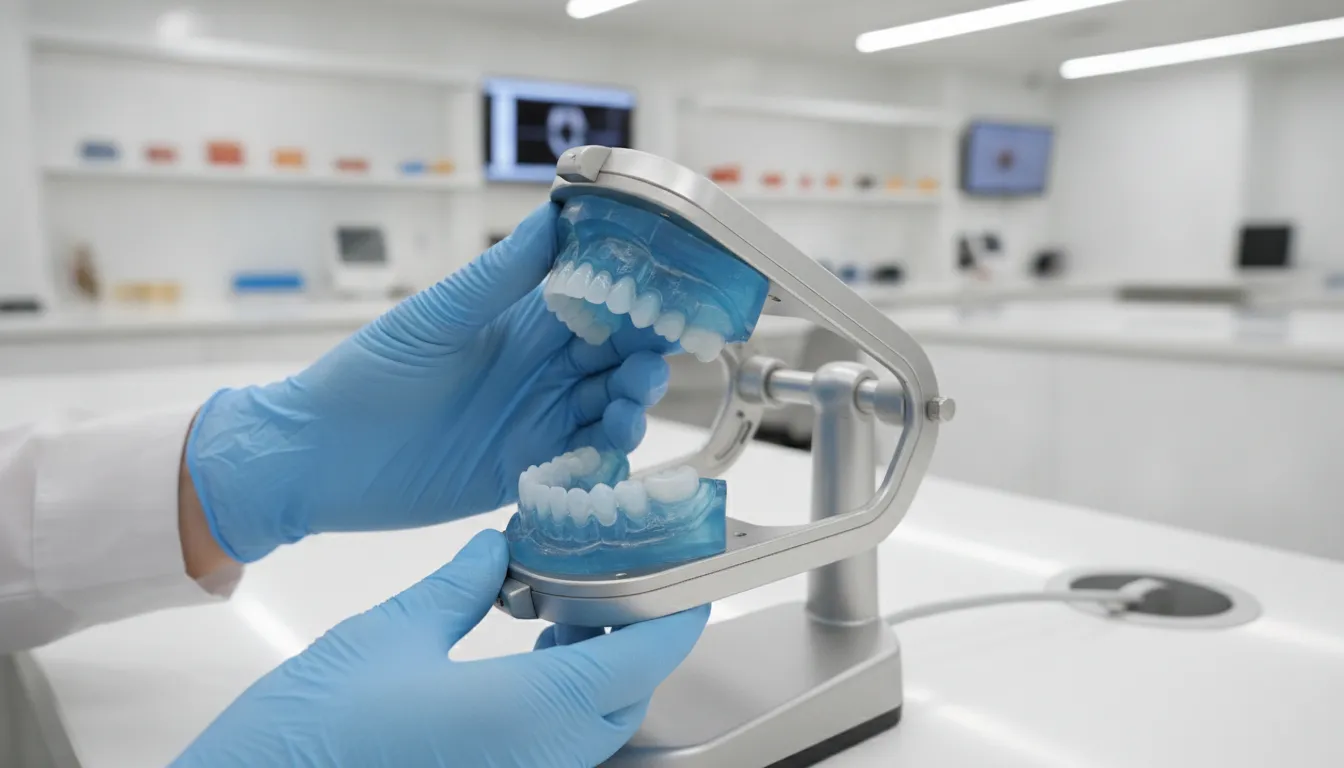
How to Record Centric Relation for Dentures
The specific registration technique may vary with the patient, the clinician's training, and the laboratory workflow. Regardless of technique, the essential controls remain consistent: stable bases, an accepted vertical dimension, relaxed guided closure, a repeatable endpoint, and verification before submission.
- Seat and test both record bases. Confirm complete seating and stability independently, then test them together through gentle opening and closure.
- Confirm the planned vertical dimension. Recheck facial support, phonetics, interocclusal space, comfort, and controlled rim contact.
- Prepare positive indexing. Create stops or notches that stabilize the registration while avoiding contact patterns that can deflect the mandible.
- Coach and guide closure. Ask the patient to relax, practice the movement, and close slowly while the clinician uses a familiar, controlled guidance method.
- Capture the relationship. Apply an appropriate amount of registration material, guide closure to the established vertical dimension, and maintain the position without excessive pressure until the material sets.
- Remove and inspect the record. Check for distortion, show-through, incomplete seating, rocking, or contact that may have displaced a base.
- Repeat and verify. Make additional guided closures and confirm that the same position and indexing relationship can be reproduced.
Use guidance without forcing the mandible
The patient should be positioned comfortably, with the head and neck supported as appropriate for the selected technique. Explain the movement in plain clinical language and rehearse it before introducing registration material. The clinician may use a gentle bilateral manipulation method, chin-point guidance, or another established technique, but the objective is controlled rotation and repeatability rather than posterior force.
If the patient braces, protrudes, or closes inconsistently, pause. Ask the patient to open slightly, relax the jaw, and repeat a short range of closure. Swallowing or brief tongue-position instructions may help some patients find a repeatable pathway, but any maneuver should be verified rather than assumed to produce the intended relation.
Control the registration material
Use enough material to capture the indexing relationship, but avoid bulk that increases resistance or prevents the rims from reaching the accepted vertical dimension. Seat the bases before guiding closure and stabilize them without compressing displaceable tissues. Once set, remove the record carefully, trim excess that interferes with reseating, and confirm that it returns to the same position on the rims.
The concise steps above can support a standard operating protocol, but they do not replace clinical judgment. A difficult record should be repeated or captured with a different technique rather than sent with uncertainty.
Verify the Record Before Digital or Laboratory Transfer
Verification is the decisive step between a plausible record and a clinically dependable one. Before accepting the registration, reseat the bases and record, then guide several closures. The rims or verification stops should meet consistently without rocking, sliding, or a visible change in the selected vertical dimension.
Use a repeatability check
Perform at least several independent guided closures, allowing the patient to open and relax between attempts. Observe the initial point of contact and whether the mandible reaches the same endpoint each time. When possible, remove and reseat the registration to confirm that the transfer itself is stable. If a second record does not agree with the first, do not choose one arbitrarily; identify and control the source of inconsistency.
Evaluate the relationship from the front and both sides. Confirm that the midline and reference markings remain coherent, the occlusal plane has not changed, and neither base lifts during closure. Recheck the planned vertical dimension after the registration is in place. A rigid record can still be wrong if it was made while a base was displaced.
Separate jaw-relation errors from base and rim errors
When the closure is not repeatable, first inspect the physical records. A rocking base, an overextended border, a distorted rim, or registration material trapped between unintended surfaces can mimic mandibular inconsistency. Correct these issues before changing the guidance technique. If the records are stable but the patient cannot repeat the movement, reassess comfort, instructions, neuromuscular control, and the proposed vertical dimension.
See how verified clinical records move through the AvaDent digital workflow
Document the accepted relationship
Record the technique used, the selected vertical dimension reference, how repeatability was verified, and any clinical limitations that may affect design or delivery. Provide clear photographs when requested, especially frontal and profile views of the rims in position and images of key markings. If an existing prosthesis or diagnostic setup informed the plan, explain which features should be preserved and which should be changed.
For teams standardizing their submissions, the digital denture planning guide can help align clinical capture with the broader case workflow. Complete documentation reduces ambiguity; it does not compensate for an uncertain record.
Troubleshooting Inconsistent Jaw Relation Records
When a record cannot be reproduced, the safest response is to stop and diagnose. Repeating the same unsuccessful maneuver without changing the conditions can reinforce an acquired closure, fatigue the patient, or produce multiple conflicting records. Use the observed pattern to determine whether the primary issue is base stability, vertical dimension, patient movement, material handling, or transfer.
| Observed problem | Likely contributors | Clinical response |
|---|---|---|
| Mandibular base lifts during closure | Poor adaptation, border interference, excessive registration pressure, or rim contact outside the supporting area | Adjust or remake the base as indicated, reduce interfering contacts, and verify stability before recording again. |
| Repeated closures end at different positions | Patient guarding, unclear instructions, an acquired closure pattern, discomfort, or insufficient guidance control | Pause, relax and coach the patient, rehearse a short closure path, reassess comfort, and compare records made with a controlled technique. |
| Vertical dimension changes when the record is inserted | Excess material, incomplete seating, distorted rims, or registration stops that do not fully index | Trim interferences, confirm full seating, verify the selected vertical dimension, and remake the record if needed. |
| Record rocks or does not reseat on the rims | Distortion during removal, flexible material, undercuts, debris, or inadequate indexing | Inspect and clean the surfaces, improve indexing, select an appropriate material, and recapture the relationship. |
| Try-in shows an apparent slide into contact | Inaccurate jaw relation, processing or transfer discrepancy, premature contact, or unstable trial bases | Verify base seating first, mark the initial contact, reassess the jaw relation clinically, and communicate the corrected record rather than adjusting blindly. |
Managing difficult clinical presentations
Patients with severely resorbed ridges, mobile tissues, limited neuromuscular control, or a long-standing acquired closure may require more appointment time and a modified protocol. Stabilization, repeated practice, or a technique that reduces reliance on compressible rims may improve record quality. When the proposed vertical dimension contributes to strain or inconsistent closure, reassess it rather than attempting to guide through the resistance.
Document uncertainty explicitly. If the relationship remains difficult to establish, communicate what was observed and what was done to manage it. A transparent clinical note allows the laboratory and design team to interpret the submitted records appropriately and identify where additional verification may be valuable.
Integrating Centric Relation Into a Digital Denture Workflow
Digital tools can capture, preserve, and transfer detailed geometry, but the quality of the prosthetic plan still depends on the clinical relationship represented by that geometry. A scan of unstable record bases or an inconsistent closure is a precise digital representation of an unreliable record. The clinical objective remains the same: produce a repeatable relationship and transfer it without introducing movement or ambiguity.
Capture a coherent dataset
Follow the laboratory's requested sequence for edentulous anatomy, record bases or rims, jaw relation, and supplementary records. Ensure that scans contain adequate, clean geometry for alignment and that the bases remain seated during the jaw-relation scan. If movement occurs, repeat the scan after correcting the cause rather than relying on software alignment to resolve a clinical discrepancy.
Reference markings, photographs, and written instructions should agree with the digital files. Conflicting midlines, vertical dimension instructions, or tooth-position requests create avoidable design uncertainty. Before submission, review the complete case as if you were the receiving technician: confirm that the intended relationship, esthetic plan, and clinical priorities are all evident.
Use digital records to support verification and communication
A digital workflow can make it easier to review records, share case information, and retain an approved design for future reference. It also supports deliberate checkpoints. The clinician can evaluate a proposed setup at try-in, relate any observed discrepancy to the original records, and communicate corrections with clear descriptions and images.
The AvaDent case workflow overview outlines how clinical information progresses through planning and production. For broader preparation guidance, consult the clinician's guide to digital dentures. These resources are most effective when the submitted jaw relation has already been verified chairside.
Evaluate the relationship at try-in and delivery
At try-in, confirm base seating before evaluating occlusion. A base that is not fully seated can present as an occlusal discrepancy even when the design reflects the submitted relationship. Assess esthetics, phonetics, vertical dimension, and centric contacts in an organized sequence. If a discrepancy is present, determine whether it originates in seating, jaw relation, tooth arrangement, or the clinical plan before requesting a correction.
At delivery, repeat the same discipline. Seat the prostheses completely, evaluate tissues and borders, then assess centric and eccentric contacts according to the prescribed occlusal scheme. Document significant adjustments and communicate any finding that may inform future remakes or replacements.
Clinical Checklist for a Defensible Record
A consistent checklist helps the team avoid accepting a record simply because the appointment is running long. Before submission, confirm that the patient was comfortable, both record bases were stable, the vertical dimension and esthetic references were accepted, and the guided closure was repeatable. Inspect the record outside the mouth and again after reseating it. Confirm that the transfer materials and digital files do not alter the relationship they are intended to preserve.
- Record bases seat fully and remain stable during closure.
- Rim contours, occlusal plane, lip support, and reference markings are complete.
- The proposed vertical dimension has been evaluated clinically.
- The patient can repeat the guided closure without force or obvious deflection.
- The registration reseats positively and does not rock.
- Multiple closures agree with the accepted relationship.
- Scans, photographs, and written instructions describe one coherent plan.
- Any limitation or uncertainty is documented before submission.
Centric relation for dentures is strongest when it is approached as a verified clinical process, not a single material record. Stable foundations, deliberate guidance, repeatability testing, and clear transfer give the restorative team a dependable reference for design and evaluation.
Frequently Asked Questions About Centric Relation for Dentures
What makes a centric relation record clinically acceptable?
A clinically acceptable record is made on stable, fully seated bases at an evaluated vertical dimension, reseats without rocking or distortion, and can be reproduced through multiple guided closures. It should also transfer clearly with supporting markings, scans, photographs, and written instructions as required.
How many times should centric relation be verified?
The relationship should be checked through several independent guided closures rather than accepted after one attempt. The important criterion is agreement: the same endpoint and indexing relationship should recur without base movement, forced guidance, or a change in vertical dimension.
What should a clinician do when two centric relation records disagree?
Do not select one arbitrarily. Reassess base stability, rim contact, vertical dimension, patient comfort, guidance, and material handling. Correct the identified source of inconsistency, then make and compare new records until a repeatable relationship is established or the clinical limitation is documented.
Can a digital scan correct an inaccurate centric relation record?
No. A digital scan can transfer the relationship that was captured, but it cannot determine that an unstable base moved or that the patient closed inconsistently. Verify the clinical relationship before scanning, repeat any scan affected by movement, and provide a coherent set of records for design.