




Clinical data show that tooth loss through debonding affects approximately 10% of standard denture wearers. This common failure creates unnecessary chair time and erodes patient trust. Using a monolithic single-unit design can help prevent these issues entirely.
Ready to eliminate tooth pop-offs in your practice? Contact AvaDent today to learn about monolithic digital denture solutions.
A monolithic digital denture is milled from a single block of pre-cured PMMA, joining teeth and base into one seamless piece. This eliminates the bond line that causes tooth pop-offs in traditional dentures and provides nearly double the flexural strength compared to conventional acrylic.
Clinical success depends on materials that can withstand daily masticatory forces. To understand why monolithic milling outperforms traditional fabrication, clinicians must first examine the fundamental flaws in bonded denture construction.
The Problem with Bonded Denture Construction
Traditional denture fabrication relies on a multi-part assembly process. Laboratories bond acrylic teeth to a pink polymethyl methacrylate base using cold-cure or heat-cure resin. This creates a physical joint that represents a significant failure point. While complete digital dentures (milled, monolithic) offer an alternative, many labs continue using conventional methods with predictable consequences. The bond between tooth and base weakens over time under normal use, leading to the most common patient complaint in restorative dentistry: the tooth pop-off. For the dentist, each failure translates to additional chair time, lab fees, and lost revenue.
Physical bond failure and degradation
The resin bond in a conventional denture experiences constant mechanical stress. Each chewing cycle applies force to the tooth-to-base interface. Over months and years, this cyclic loading creates micro-cracks along the bond line. Salivary enzymes and oral fluids accelerate this degradation by penetrating microscopic gaps and chemically attacking the bonding agent. This process progressively compromises the structural integrity of the entire arch. Because the bond is an adhesive layer rather than a unified material, it remains vulnerable regardless of laboratory technique. Even the best-equipped dental labs struggle to create a bond that reliably survives the oral environment for extended periods. Each tooth-loss event damages the clinician-patient relationship. When a tooth pops off during eating, the patient experiences embarrassment and discomfort. The repair cycle involves additional lab fees, shipping costs, and chair time. For a busy practice, these incremental repairs represent a substantial drain on both time and revenue.
Clinical failure rates with conventional dentures
Research confirms that debonding is not rare. A longitudinal study indexed in the National Library of Medicine tracked complete denture outcomes over extended follow-up periods. The data show that 10.9% of patients experienced tooth loss in at least one denture. Dorner et al. reported denture base fractures in 5.8% of patients and tooth loss in another 5.8%. While dentures can achieve clinically useful lifespans averaging 15.8 years (mandibular) and 19.4 years (maxillary), they typically require multiple repairs to remain functional. These statistics highlight a clear gap in conventional denture care. The bond line represents an inherent weak point that compromises an otherwise functional restoration.
- 10.9% of patients experience tooth loss from conventional dentures
- 5.8% experience base fractures requiring replacement
- 5.8% experience isolated tooth detachment events
- Average denture lifespan: 15.8 years (mandibular) to 19.4 years (maxillary)
Thermal cycling effects on bond integrity
Thermal cycling further compromises bonded denture integrity. During normal eating, patients consume foods and beverages at varying temperatures, causing denture components to expand and contract at different rates. This differential movement places additional strain on the tooth-base interface, accelerating fatigue at the bond line. A 2023 study by Amr Mohamed demonstrated that conventional bond strength degrades significantly after thermal cycling exposure. In contrast, a monolithic digital denture maintains superior strength under identical conditions because it has no bond line to fail. By adopting modern digital denture workflows, clinicians can eliminate this failure mechanism entirely.
What Makes a Monolithic Digital Denture Different
A monolithic digital denture is a single-piece prosthetic milled from a uniform PMMA block. Unlike conventional dentures that bond separate teeth to a base, this design has no interfaces, seams, or adhesive layers that can fail under clinical use.
A monolithic digital denture is a single, continuous structure. The teeth and base originate from one block of high-density material, rather than separate components joined by resin. By fabricating the restoration as one piece, laboratories using complete digital dentures milled monolithic eliminate the weak points inherent in multi-part construction. This method creates a restoration with no seams that could fracture or debond over time.
Single-piece fabrication
The fundamental innovation in monolithic fabrication is the production process itself. Technicians use a puck of densely packed, multi-chromatic PMMA that incorporates the optical and mechanical properties of both tooth and base materials in a single block. A computer-controlled milling machine carves the complete denture form from this block in one continuous operation. Because the teeth and base are physically continuous, they remain permanently united. This directly addresses tooth pop-offs, the most frequent mechanical failure in conventional dentures. Peer-reviewed research in the Journal of Prosthetic Dentistry confirms that milled monolithic restorations demonstrate superior mechanical properties compared to multi-step fabricated alternatives. The result is a dense, smooth restoration that performs reliably under clinical conditions.
Digital workflow versus manual fabrication
Modern digital workflows utilize intraoral scans and CAD software to plan each case with precision. Conventional workflow involves wax try-ins, flasking, packing, and boil-out procedures. Each manual step introduces potential error and creates opportunities for gap formation at the tooth-base interface.
- Scanning: Digital impression captures accurate tissue morphology
- Design: CAD software optimizes occlusion and tooth positioning
- Milling: Single-block fabrication eliminates assembly steps
- Finishing: Minimal manual adjustment required due to milled precision
By using a single-disc milling path, laboratories ensure that the restoration remains unified for its entire clinical lifespan. This precision leads to superior fit and long-term stability for patients requiring full-arch rehabilitation.
Material Strength: XCL and the Science of Milled PMMA
AvaDent XCL PMMA uses a cross-linked polymer structure that provides nearly double the flexural strength of conventional denture acrylic. This material is milled from a single block to eliminate porosity and bond-line failure points.
The transition to milled polymers has fundamentally changed how clinicians evaluate denture material strength. Conventional dentures rely on mechanical and chemical bonds that degrade under functional loading. In contrast, a monolithic digital denture is milled from a single block of XCL cross-linked PMMA, eliminating the weak tooth-base interface entirely.
Cross-linked polymer chemistry
XCL material is built on a three-dimensional network of covalent polymer bonds. Conventional acrylic consists of linear polymer chains that can slide past one another under load, leading to wear and dimensional change. In XCL, these bonds function as cross-links that lock the polymer chains into a rigid, stable matrix. During disc manufacturing, the polymer chains are cross-linked under controlled heat and pressure to create an exceptionally dense structure without the shrinkage or internal stress of traditional processing. This chemical architecture delivers measurable clinical advantages. The material is virtually 100% porosity-free, eliminating the microscopic voids where food debris and microorganisms can accumulate in conventional acrylic. Research published in the Journal of Prosthetic Dentistry confirms that milled monolithic restorations distribute occlusal forces more uniformly than layered alternatives, reducing the risk of catastrophic failure.
Mechanical performance data
Material density directly influences how a denture performs under functional loads. Milled XCL PMMA is designed to deliver approximately two times the flexural strength of conventional heat-cured denture acrylic, with some test configurations showing up to eight times the fracture resistance. This strength margin is especially valuable for implant-supported prostheses and patients with elevated bite forces.
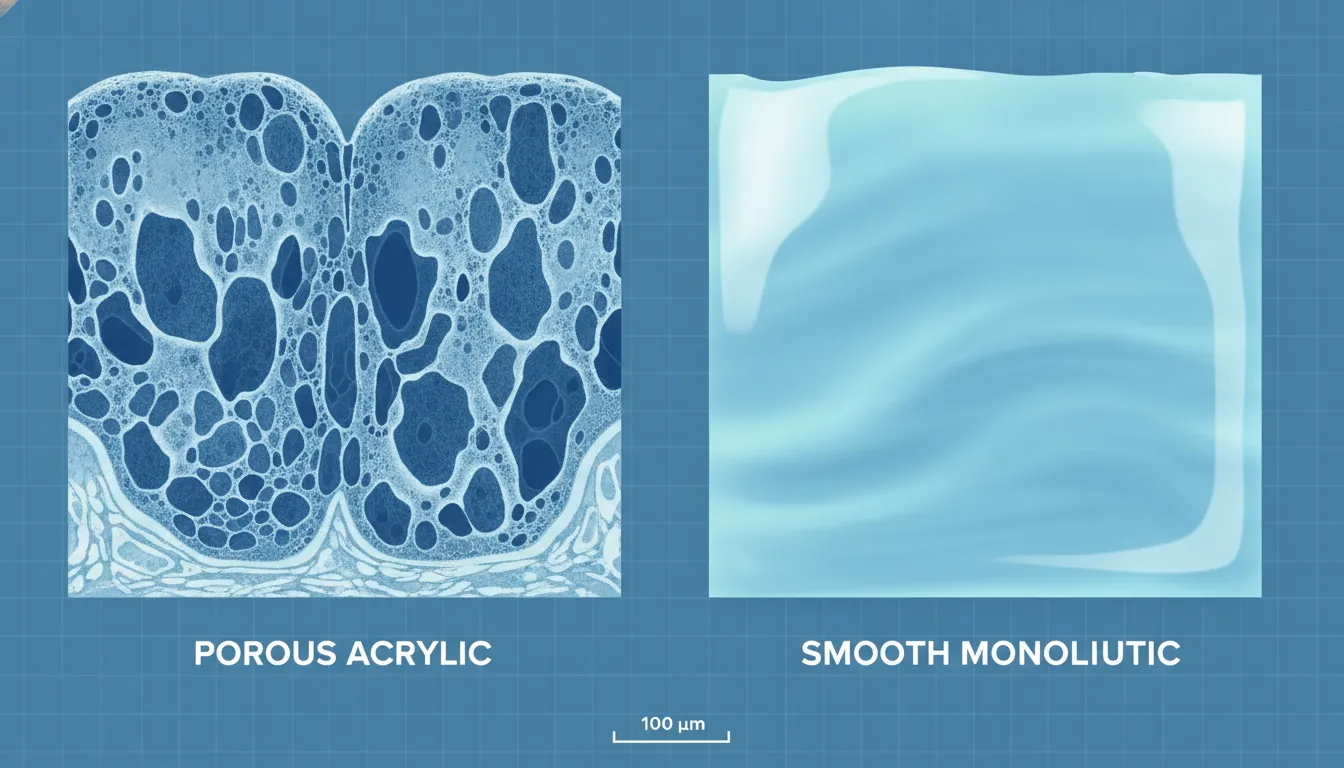
The absence of internal porosity eliminates crack initiation sites that compromise conventional acrylic. Studies tracking conventional denture outcomes report 10.9% tooth-loss rates attributable to bond-driven failures.
A monolithic design eliminates this failure vector by creating the tooth and base as a continuous unit rather than separate adhered components.
For clinicians evaluating material options, detailed technical specifications for digital denture technology and material science are available on the AvaDent website.
Milled versus 3D-printed precision
While additive manufacturing offers speed advantages, subtractive milling still leads in material density, flexural strength, and minimum achievable thickness. Milled XCL allows a minimum cross-sectional thickness of 1.5 mm compared to the 2.0 mm minimum typically required for 3D-printed dentures. This thinner profile improves patient comfort by creating more intraoral space for the tongue and enhancing speech adaptation. The XCL milling blank is homogeneous throughout its volume, unlike printed restorations that exhibit layer-to-layer interfaces. Fracture toughness studies demonstrate that milled PMMA bases outperform printed alternatives under simulated masticatory loads.
| Property | Monolithic XCL (Milled) | Conventional (Hand-Packed) | 3D-Printed (Additive) |
|---|---|---|---|
| Flexural Strength | Nearly 2x conventional | Baseline | Varies by resin chemistry |
| Minimum Thickness | 1.5 mm | 2.0-3.0 mm | 2.0 mm |
| Porosity | Virtually 0% | Moderate to high | Low to moderate |
| Tooth Retention | Permanent (no bond line) | Mechanical bond (prone to failure) | Chemical bond (interface exists) |
| Density | High, uniform | Variable, inconsistent | High but layered |
Clinical Outcomes: Fewer Adjustments and Appointments
Digital monolithic denture workflows reduce the number of clinical appointments, with approximately 95% of cases completed in five or fewer visits. The single-piece design also eliminates bond-related failures that require repair appointments.
Adopting a monolithic digital denture workflow can meaningfully improve practice efficiency. Digital fabrication reduces the time investment required from both clinician and patient. Studies show that streamlined digital workflows allow approximately 95% of complete denture cases to reach delivery in five or fewer appointments. This efficiency enables clinicians to treat more patients while maintaining high quality standards.
Streamlined clinical workflow
Monolithic digital dentures are designed to provide superior fit from the initial insertion. Clinical data indicate that these prosthetics offer up to 45% better retention than conventional designs, with a 37% improvement in patient-reported outcomes over 18 months of use. Clinicians can review the full CAD/CAM denture product line to evaluate how these restorations integrate with existing practice workflows. Improved fit translates directly to fewer post-insertion complaints and adjustment visits. AvaDent Adaptive Occlusion software contributes to this precision by calculating a near-ideal occlusal scheme for each case. This technology consistently produces restorations requiring minimal or no chairside adjustment at delivery.
Long-term reliability and digital record retention
Conventional dentures accumulate mechanical problems over time. Research indicates that approximately 5.8% of conventional denture patients experience base fractures, while a similar proportion experience tooth detachment. Monolithic digital dentures avoid these failure modes because the continuous single-block design has no bonded interfaces to compromise. This structural integrity is especially valuable for patients with parafunctional habits or those with implant-supported prostheses requiring elevated material strength. Every monolithic case benefits from permanent digital record storage. If a patient loses or damages their denture, the laboratory can mill an exact replacement from the archived digital file without requiring new impressions or additional patient visits. This archival capability provides security for both clinician and patient, ensuring that a precise replacement is always available. Clinicians can explore digital denture design workflows to understand how CAD/CAM precision contributes to long-term reliability.
The Biohygienic Advantage of Non-Porous Monolithic Surfaces
The non-porous surface of monolithic PMMA resists bacterial biofilm formation and stain accumulation. This material property reduces the risk of denture stomatitis and improves long-term oral health outcomes.
Surface quality directly influences long-term oral health in denture patients. Conventional denture acrylic contains microscopic surface porosity that creates reservoirs for microbial colonization. A monolithic digital denture addresses this issue through dense material structure and precision milling.
Surface density and monomer reduction
The high-pressure fabrication process for monolithic digital dentures produces a surface that is virtually 100% porosity-free. Conventional processing methods leave microscopic voids in the acrylic that occur during the curing phase and create pathways for fluid absorption and bacterial penetration. Single-disc milling eliminates these voids by using pre-polymerized blanks that are dense throughout. This density also reduces residual monomer content. In conventional dentures, unpolymerized methyl methacrylate monomer can act as a plasticizer, gradually creating additional surface porosity over time. AvaDent XCL material is formulated to be nearly monomer-free, maintaining surface integrity for the clinical lifespan of the restoration. Detailed information on advanced digital denture technology is available for clinicians evaluating material options.
Biofilm resistance and clinical significance
A non-porous surface represents an important defense against pathogenic oral biofilms. Conventional dentures contain a bonded seam between tooth and base material that creates a microscopic crevice ideal for bacterial colonization. Organisms such as Candida albicans and Streptococcus species readily colonize these areas and are difficult to remove with routine hygiene. Persistent colonization can lead to chronic mucosal inflammation and infection.
- Denture stomatitis risk: Reduced by eliminating porous surfaces and seam lines
- Biofilm accumulation: Minimized through smooth, non-porous material surface
- Patient hygiene: Simplified maintenance with fewer areas for debris retention
- Oral malodor: Reduced by eliminating odor-trapping porosity
Research on monolithic material properties confirms that restorations without bond lines or porosity demonstrate better resistance to microbial colonization. The smooth surface finish reduces bacterial adhesion and makes routine cleaning more effective. This is clinically significant because biofilm accumulation is a primary causative factor in denture stomatitis. A condition affecting up to 67% of denture wearers that causes mucosal erythema and discomfort. Fresher breath is an additional benefit appreciated by patients. Porous conventional acrylic absorbs oral fluids and odors that cannot be removed by brushing alone, contributing to what patients describe as denture odor. Monolithic surfaces do not absorb these compounds, supporting patient confidence in social situations.
Selecting Appropriate Cases for Monolithic Digital Dentures
Monolithic digital dentures are most appropriate for patients with high bite forces, parafunctional habits, previous denture fractures, or implant-supported prostheses requiring maximum material strength.
Patient selection directly influences clinical outcomes with monolithic dentures. While most edentulous patients can benefit from digital fabrication, the monolithic digital denture offers specific advantages for high-load clinical scenarios. These restorations are milled from a single material block, eliminating the tooth detachment risk inherent in bonded designs.
High-bite-force patients and bruxism
Clinicians frequently encounter challenges with patients who generate elevated occlusal forces or clench and grind. In conventional dentures, these forces transmit directly to the tooth-base bond, causing progressive fatigue and eventual pop-off. The base itself may fracture under concentrated load. Longitudinal data show that approximately 10.9% of conventional denture patients experience tooth loss attributed to bond failure. Monolithic construction addresses this by eliminating the bond interface entirely. These restorations provide nearly twice the strength of conventional alternatives, making them suitable for patients with high functional demands. The high-density XCL material resists the fatigue cracking that leads to base fracture in conventional acrylic. This is especially relevant for implant-supported overdentures, where the prosthetic must withstand concentrated load transfer at attachment points.
Patients with histories of repeated repairs
Patients who have experienced multiple denture repairs are strong candidates for monolithic conversion. Each repair cycle consumes chair time, laboratory resources, and patient goodwill. Monolithic digital dentures fabricated through modern digital denture workflows provide a definitive solution for patients frustrated by recurrent failures. The permanent digital record also ensures that a replacement can be fabricated rapidly without repeating the impression and fitting process. Providing additional value for patients with complex medical histories or limited access to care.
Cost-benefit considerations
While monolithic digital dentures carry a higher initial laboratory fee than conventional dentures. The total cost of care over the restoration lifespan often favors the monolithic option when factoring in repair avoidance. Each tooth pop-off in a conventional denture generates lab fees, shipping costs, and uncompensated chair time. For the patient, the convenience of fewer repairs represents meaningful quality-of-life value. For clinicians, reduced post-delivery complications translate to fewer emergency appointments and higher practice satisfaction.
Ready to eliminate tooth pop-offs in your practice? Contact AvaDent today to learn how monolithic digital denture technology can improve your clinical outcomes. Call (480) 275-7144 to speak with our team.