




Locator Fixed Denture: Indications, Workflow, and Patient Benefits
A locator fixed denture can be a practical middle path when a patient wants the confidence of a fixed full-arch restoration, but the case does not call for a more complex screw-retained prosthesis. For dentists and prosthodontists, the decision is not simply fixed versus removable. It is a question of anatomy, hygiene access, restorative space, patient dexterity, maintenance expectations, and the digital workflow that will support a predictable final prosthesis.
Planning a full-arch removable, fixed, or implant-retained case? Contact AvaDent to discuss case planning and digital denture workflow options.
This guide explains when a locator fixed denture may be appropriate, where conventional removable dentures or implant-retained overdentures may still be the better choice, and how AvaDent solutions such as digital overdentures, Snap-Pin denture solutions, and AvaMax implant-supported dentures can support more predictable full-arch treatment.
What Is a Locator Fixed Denture?
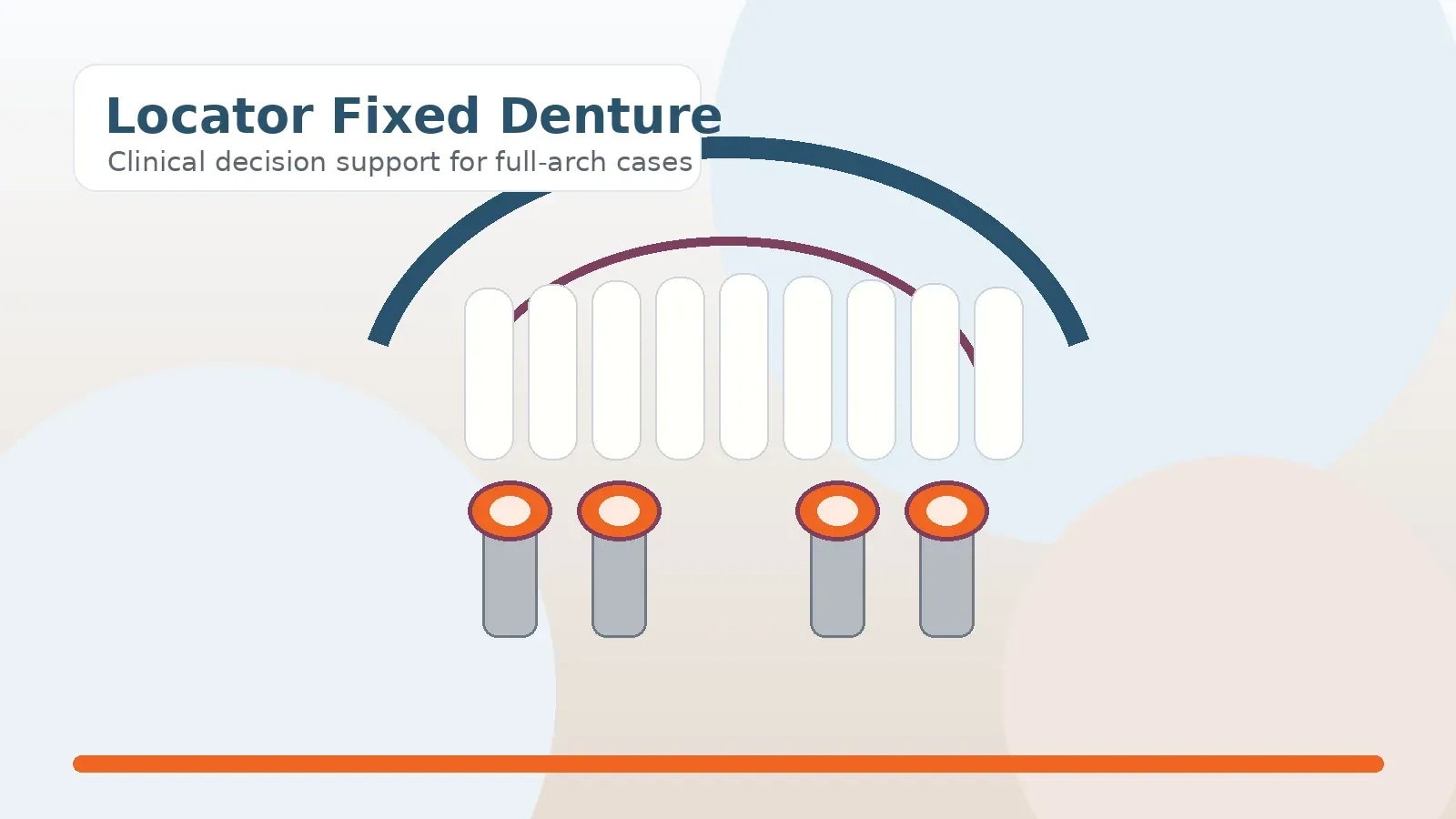
A locator fixed denture is a full-arch implant prosthesis retained by LOCATOR-style abutments and fixed attachment inserts. The prosthesis is designed to feel fixed to the patient during normal function, but it can be removed by the clinician with the proper tool for service, cleaning, insert replacement, or prosthetic maintenance.
That distinction matters. A conventional removable overdenture is removed daily by the patient for hygiene. A screw-retained hybrid is generally fixed to multi-unit abutments and removed by the clinician through screw access channels. A locator fixed approach sits between those categories. It can use familiar locator abutment concepts while creating a more fixed patient experience than a removable overdenture.
In clinical decision-making, the phrase should not be used as a generic synonym for every implant denture. It describes a specific retention concept: a full-arch prosthesis that engages locator abutments with fixed inserts, typically as a patient-fixed, clinician-removable restoration.
Where Locator Fixed Fits in the Full-Arch Treatment Spectrum
For edentulous and soon-to-be edentulous patients, the treatment spectrum usually includes four broad categories:
- Conventional complete dentures: tissue-supported prostheses with no implant retention.
- Removable implant overdentures: patient-removable prostheses retained by locator attachments, bars, or other retentive components.
- Locator fixed dentures: patient-fixed, clinician-removable full-arch restorations retained by locator-style components.
- Screw-retained fixed hybrids: clinician-removable prostheses retained by prosthetic screws, often using titanium, zirconia, PMMA, or hybrid materials.
The best option depends on the patient, not on the novelty of the attachment. A locator fixed denture may be attractive when the patient strongly dislikes removing a prosthesis, wants more psychological security than a snap-in overdenture, and has enough implant distribution and restorative space to support the design. A removable overdenture may be preferable when hygiene access is a major concern, manual cleaning by the patient is reliable, budget is constrained, or the clinician wants simpler long-term serviceability.
Primary Indications for a Locator Fixed Denture
A locator fixed denture is most compelling when the clinical and behavioral profile points toward a stable full-arch solution with simplified maintenance compared with some screw-retained options.
Patients who want a fixed feel without a complex fixed hybrid
Some patients reject conventional dentures because of movement, sore spots, food limitations, or social anxiety. They may also resist a fully screw-retained hybrid because of cost, restorative complexity, or anatomy. In these cases, a locator fixed denture can provide a fixed-feeling outcome while using attachment concepts that many practices already understand.
Existing locator overdenture patients seeking an upgrade
Patients who already wear removable locator overdentures may ask for a restoration that feels more permanent. If the implants, abutments, vertical space, prosthesis design, and hygiene plan are appropriate, a locator fixed concept may offer an upgrade path without automatically moving to a full screw-retained hybrid workflow.
Edentulous patients with limited tolerance for denture movement
Patients with gagging, poor neuromuscular control, low tolerance for movement, or high functional expectations may struggle with a conventional complete denture. Implant assistance can improve stability. A fixed attachment approach can reduce the patient perception of a removable appliance.
Cases where retrievability remains important
Full-arch prosthetics require maintenance. Inserts wear. Tissue changes. Occlusion evolves. Prostheses need cleaning, repair, or replacement. A locator fixed denture preserves clinician retrievability, which can be helpful for practices that want fixed function without sacrificing service access.
When Conventional Removable Dentures Are Still Appropriate
Locator fixed dentures are not a replacement for every complete denture. Conventional removable dentures remain appropriate when implants are not planned, medical factors limit surgery, financial constraints are significant, or the patient prefers a non-surgical path.
A high-quality conventional digital denture can still deliver strong value when the case is planned carefully. AvaDent's complete digital dentures use a monolithic milled design, digital records, and a documented workflow designed to reduce chair time and preserve reproducibility. For patients who need a replacement denture, an immediate denture, or a non-implant solution, a digital denture may be the right first step.
Clinically, the key is to avoid overselling fixation when tissue support and patient expectations can be managed with a precise removable prosthesis. If the patient can clean the prosthesis, accepts removal, has favorable ridge anatomy, and wants a lower-complexity option, conventional removable treatment remains a valid recommendation.
When an Implant-Retained Overdenture May Be Better
A removable implant overdenture often remains the most balanced option for patients who need more retention than a complete denture but still benefit from daily removal. The prosthesis can improve stability, chewing confidence, and comfort while preserving patient access for hygiene.
AvaDent's overdenture capabilities support implant-retained treatment planning with a digital workflow, strong materials, and prosthetic design support. The Snap-Pin denture concept is also relevant for practices that want a streamlined implant-retained option for patients who are not ideal candidates for a fixed prosthesis.
Choose a removable overdenture when daily hygiene access is essential, the patient has dexterity and motivation to remove and clean the prosthesis, the restorative space is limited, or the risk of food accumulation under a fixed prosthesis is high. For many older patients, removable access is not a compromise. It is the reason the treatment succeeds over time.
When AvaMax or a Fixed Hybrid Workflow May Be the Better Direction
AvaMax implant-supported dentures are designed for clinicians who need a high-strength, full-arch implant solution with advanced digital manufacturing support. When the case demands a robust fixed or hybrid prosthesis, the decision may move beyond a locator fixed denture and toward a purpose-built implant-supported design.
AvaMax is especially relevant when the clinician is planning a definitive full-arch prosthesis and wants a manufacturing workflow that can integrate digital design, titanium support, high-strength PMMA, and precise production. It can be a better fit when the patient has high functional demands, when the restorative plan requires reinforced architecture, or when a more comprehensive implant-supported prosthetic solution is desired.
Need help deciding between removable overdenture, locator fixed, and AvaMax pathways? Review AvaDent's digital workflow or contact the team for case-specific planning guidance.
Clinical Evaluation Criteria Before Recommending Locator Fixed
Before recommending a locator fixed denture, evaluate the case through four lenses: surgical foundation, prosthetic space, hygiene feasibility, and maintenance planning.
Implant distribution and support
Implant number, position, angulation, arch form, and anterior-posterior spread all influence whether a full-arch prosthesis can function predictably. A locator fixed denture should not be used to compensate for an unstable implant plan. If implant distribution is poor, the prosthetic design will inherit that weakness.
Restorative space
Every attachment system needs room for housings, inserts, prosthetic material, tooth position, cleansable contours, and adequate thickness. Limited vertical space can force compromises that affect strength, esthetics, or hygiene. Digital planning helps identify those constraints before fabrication.
Hygiene access
A patient-fixed prosthesis requires a different hygiene conversation than a removable overdenture. The patient must understand how to clean under and around the prosthesis, and the clinician must plan recall intervals that match the patient's risk profile. If hygiene access is likely to fail, a removable overdenture may be safer.
Material and fracture risk
Full-arch prostheses experience significant functional load. Material selection, minimum thickness, occlusal scheme, and reinforcement strategy should be matched to the patient's parafunction, opposing dentition, and implant support. AvaDent's digital manufacturing and material options can help reduce variability compared with conventional analog processing.
Digital Workflow Considerations
A digital workflow improves the locator fixed denture conversation because it allows the practice and lab team to evaluate records, design constraints, and prosthetic objectives before production. The workflow may include intraoral scans, reference denture scans, bite records, implant records, photographs, and digital design review.
AvaDent supports multiple full-arch workflows, including reference denture protocols and scanner-based record submission. The goal is not digitization for its own sake. The goal is fewer remakes, fewer adjustment appointments, better record preservation, and a repeatable pathway when the patient needs service or replacement later.
For practices still building confidence with implant prosthetics, AvaDent's education and training resources can help standardize records, case selection, and chairside execution. Practices can also use AvaDent's clinical protocols to align the team before the first appointment.
Patient Benefits to Explain Clearly
Patients do not usually ask for a locator fixed denture by component name. They ask for teeth that feel secure, look natural, and let them eat and speak with confidence. Translate the clinical recommendation into practical benefits:
- More security during function: less perceived movement than many removable dentures.
- Clinician retrievability: the dentist can remove the prosthesis for service when needed.
- Potential upgrade path: some patients with existing locator-based treatment may have options beyond removable overdentures.
- Digital reproducibility: digital records can support future remake or replacement workflows.
- Clearer expectations: patients understand that fixed does not mean maintenance-free.
The final point is critical. Fixed prosthetics still need professional care. The patient should leave the consultation understanding hygiene responsibilities, recall frequency, possible insert wear, prosthesis service needs, and the difference between patient-removable and clinician-removable designs.
How to Present the Decision to Patients
A simple chairside framework can make the discussion easier:
| Option | Best fit | Main tradeoff |
|---|---|---|
| Conventional removable denture | Non-surgical, lower-complexity treatment | Less implant-assisted retention |
| Removable implant overdenture | Improved retention with daily hygiene access | Patient must remove and clean it |
| Locator fixed denture | Fixed-feeling full-arch option with clinician retrievability | Requires hygiene discipline and planned maintenance |
| AvaMax or fixed hybrid solution | More comprehensive implant-supported prosthetic planning | Higher complexity and more detailed restorative planning |
Use this framework to make the recommendation feel objective. If the patient values daily removal and easier cleaning, do not force a fixed pathway. If the patient is unhappy with removable function and has a favorable implant foundation, discuss fixed-feeling options with clear maintenance expectations.
Case Planning Questions for the Dental Team
Before submitting a case, align the clinical team around these questions:
- Is the patient asking for improved retention, a fixed feel, better esthetics, easier hygiene, or all of the above?
- Does the implant plan support the prosthetic design, not just osseointegration?
- Is there enough restorative space for attachments, materials, and cleansable contours?
- Can the patient maintain a fixed prosthesis between recall visits?
- Would a removable overdenture achieve the same goals with less risk?
- Would an AvaMax or fixed hybrid workflow provide a stronger long-term solution?
- What records are needed to reduce adjustment time and avoid remakes?
If you are weighing these questions on an active case, connect with AvaDent for case planning support before finalizing the prosthetic pathway.
FAQ: Locator Fixed Dentures
What is the difference between locator fixed and removable?
A removable locator overdenture is removed by the patient for daily cleaning. A locator fixed denture is designed to stay fixed for the patient during normal use, while remaining removable by the clinician with the proper tool for maintenance.
Is a locator fixed denture the same as a screw-retained hybrid?
No. A screw-retained hybrid is retained by prosthetic screws, usually through screw access channels. A locator fixed denture uses locator-style abutments and fixed inserts. Both can be clinician-removable, but the restorative design and maintenance approach differ.
Who is a good candidate for a locator fixed denture?
A good candidate usually wants a fixed-feeling full-arch restoration, has an implant foundation that supports the design, has adequate restorative space, and can maintain hygiene around a patient-fixed prosthesis.
When is a removable overdenture better?
A removable overdenture may be better when daily hygiene access is a priority, the patient can reliably remove and clean the prosthesis, restorative space is limited, or the clinician wants a lower-complexity implant-retained solution.
How can AvaDent help with full-arch case planning?
AvaDent supports digital denture, overdenture, Snap-Pin, and AvaMax implant-supported workflows. The team can help practices evaluate records, prosthetic design, material options, and workflow steps before fabrication.
Build the Treatment Plan Around the Patient, Not the Attachment
A locator fixed denture can be a valuable option, but it is not a universal answer. The right recommendation comes from matching the patient's expectations to implant support, hygiene reality, prosthetic space, material needs, and long-term maintenance.
For some patients, the best treatment is a precise conventional digital denture. For others, it is a removable implant overdenture that improves retention while preserving hygiene access. For more complex full-arch cases, AvaMax or another implant-supported workflow may provide the stronger path. The role of the clinician is to choose the pathway that will be easiest to deliver, easiest to maintain, and most likely to satisfy the patient over time.
Ready to plan the next full-arch case? Talk with AvaDent about overdenture, Snap-Pin, AvaMax, and digital workflow options.