




Lingualized vs Bilateral Balanced Occlusion
Lingualized vs bilateral balanced occlusion is not a choice between a universally superior scheme and an inferior one. It is a clinical design decision shaped by ridge anatomy, jaw relationships, neuromuscular control, esthetic requirements, tooth selection, and the ability to record and reproduce the intended contacts. For complete denture cases, the practical objective is a stable, maintainable prosthesis whose occlusion supports the individual patient rather than a textbook ideal.
Clinical answer: Lingualized occlusion concentrates maxillary palatal cusp contacts in mandibular central fossae, while bilateral balanced occlusion seeks simultaneous contacts on both sides during centric and eccentric movements. Lingualized setups can simplify contact control and direct forces more centrally. Bilateral balance can provide cross-arch contact during excursions, but it requires accurate records, articulation, and verification. Neither scheme can compensate for an inaccurate jaw relation, unstable base, or uncorrected processing discrepancy.
Lingualized vs bilateral balanced occlusion at a glance
In brief: Both schemes are intended to support complete denture stability, but they organize posterior contacts differently. The best prescription is the one the restorative team can execute predictably for the patient's anatomy and functional pattern.
| Clinical consideration | Lingualized occlusion | Bilateral balanced occlusion |
|---|---|---|
| Primary contact concept | Maxillary lingual cusps contact mandibular central fossae | Coordinated working, balancing, and protrusive contacts |
| Force-control objective | Centralize posterior contacts and reduce competing cusp contacts | Maintain contacts across the arch during excursions |
| Setup sensitivity | Requires controlled palatal cusp-to-fossa relationships | Requires precise cusp inclinations, compensating curve, and articulation |
| Common clinical appeal | Clear contact pattern with esthetic maxillary anatomy | Cross-arch contact during eccentric function |
| Verification priority | Confirm central fossae contacts and eliminate deflective buccal cusp contacts | Confirm balanced eccentric contacts without destabilizing interferences |
This table describes design objectives, not a guarantee of clinical performance. Patient adaptation, denture-base fit, saliva, ridge morphology, and follow-up care remain important regardless of scheme.
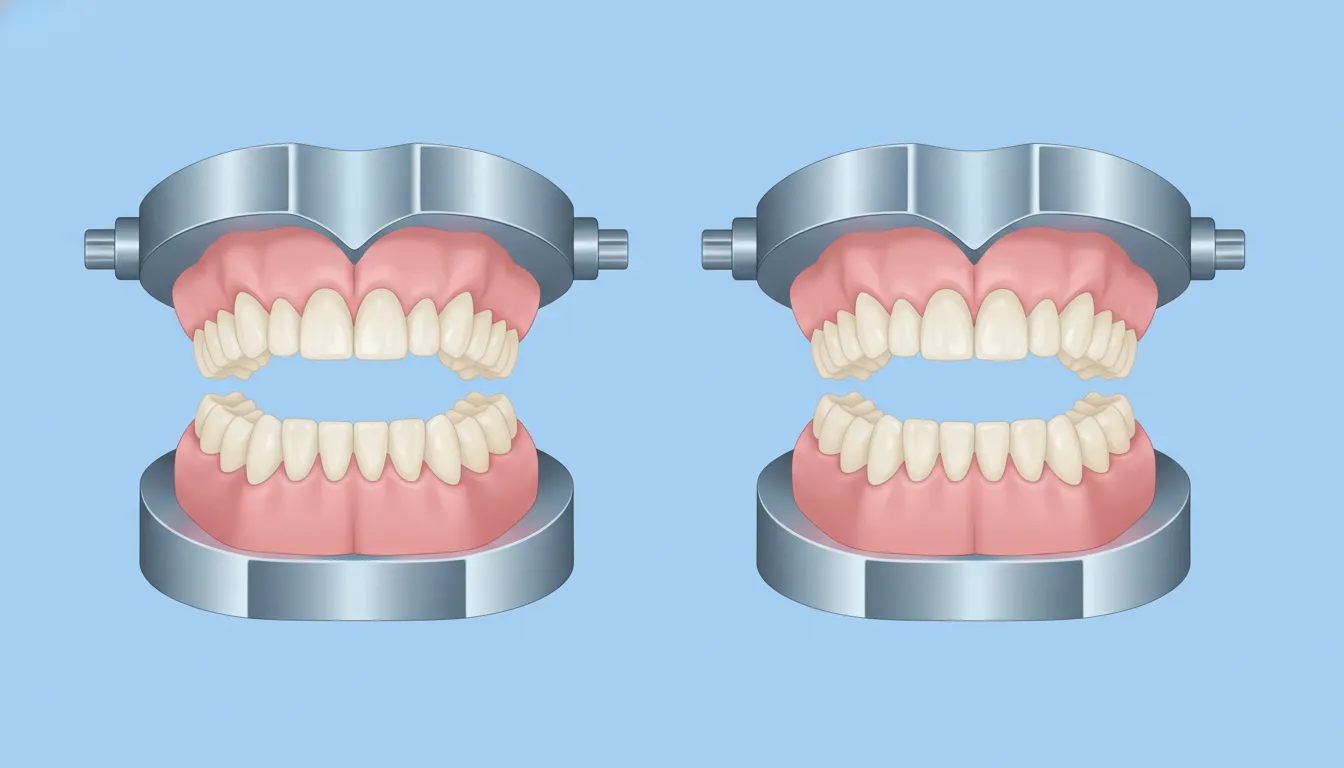
How do the two occlusal schemes differ?
Clinical answer: The central distinction is where contacts are designed and how they are managed during excursions. Lingualized occlusion emphasizes a dominant maxillary palatal cusp contact. Bilateral balanced occlusion coordinates multiple contacts through working, balancing, and protrusive movements.
Lingualized occlusion
In a lingualized arrangement, the maxillary palatal cusps are the principal functional cusps. They contact the fossae of the mandibular posterior teeth, while maxillary buccal cusps are generally kept out of functional contact. This creates a defined contact pattern that can be evaluated and adjusted without trying to preserve every opposing cusp relationship.
The scheme may be useful when the team wants anatomic-looking maxillary teeth while controlling the number and location of posterior contacts. Its success still depends on appropriate tooth position over the supporting tissues, a stable denture base, and a reproducible centric relation.
Bilateral balanced occlusion
Bilateral balanced occlusion is designed to maintain simultaneous contacts on both sides of the arch in centric and eccentric positions. Achieving that objective involves more than arranging posterior teeth. Cusp inclination, plane of occlusion, condylar guidance, incisal guidance, and compensating curve interact throughout the setup.
The presence of many contacts is not, by itself, evidence of a successful setup. Contacts must be coordinated so that excursions do not create a premature contact that tips or displaces a denture base.
When might lingualized occlusion be appropriate?
Clinical answer: Lingualized occlusion may be considered when centralized posterior contacts, controlled cusp relationships, or simplified clinical adjustment are priorities. The indication should follow the patient's anatomy and records rather than a routine laboratory default.
- Resorbed or compromised ridges: A centralized contact pattern may help the team limit lateral force components, although base extension and fit remain fundamental.
- Difficult jaw relationships: The scheme can give the technician a clear functional cusp target when arch relationships make a conventional anatomic setup challenging.
- Need for maxillary esthetics: Anatomic maxillary posterior teeth can be retained while functional contacts are concentrated on the palatal cusps.
- Anticipated maintenance: A defined cusp-to-fossa pattern can make selective adjustment easier to interpret at delivery and recall.
These are considerations, not absolute indications. Published clinical comparisons do not establish one occlusal scheme as best for every edentulous patient. A systematic review indexed in PubMed illustrates why patient-centered selection and cautious interpretation of outcome evidence are important.
See how AvaDent's digital technology supports precise, repeatable denture design.
When might bilateral balanced occlusion be appropriate?
Clinical answer: Bilateral balance may be considered when maintaining cross-arch contacts during excursions is a deliberate treatment objective and the restorative team has reliable records, articulation, and verification procedures.
A balanced arrangement can be appropriate for a patient whose anatomy and functional movements allow the intended contacts to be established without destabilizing interferences. It can also suit clinicians and laboratories with a well-defined protocol for programming the articulator, establishing the compensating curve, and remounting after processing.
The tradeoff is sensitivity. A discrepancy in centric relation, vertical dimension, tooth position, or processing can disturb the planned balance. The more contacts a setup attempts to coordinate, the more carefully each contact must be evaluated. The correct response is not to pursue balance at any cost, but to preserve stable, nondeflective contacts consistent with the prescription.
Do not treat the scheme as a substitute for stability
Neither eccentric balance nor a lingualized contact pattern can correct inadequate border extension, an unstable base, or an inaccurate impression. Occlusion is one component of the complete denture system. When a denture moves under light pressure before occlusal evaluation, the base and supporting tissues require attention first.
Records and prescriptions that support either scheme
Clinical answer: Predictable occlusion starts with an accurate, complete prescription. The laboratory needs reliable records and explicit clinical priorities, not only a checked box naming the desired scheme.
Record the foundation
Evaluate supporting anatomy, ridge relationships, interarch space, restorative space, and the condition of the mucosa. Capture impressions and border extensions appropriate to the selected clinical workflow. Verify that record bases are stable before using them to establish jaw relationships.
Establish reproducible jaw relations
Confirm vertical dimension, centric relation, midline, smile line, lip support, and occlusal plane. If the centric record is not repeatable, additional setup precision will not solve the underlying problem. Document any history of parafunction, limited neuromuscular control, or difficulty reproducing mandibular position.
Write a specific laboratory prescription
A useful prescription identifies the occlusal scheme, tooth mold and material preferences, overjet and overbite goals, esthetic priorities, and any planned compromises. It should also state which contacts are essential and which should be avoided. Digital records can improve communication, but they still require a clear clinical directive.
For clinicians evaluating a digital workflow, AvaDent provides information about its complete denture solutions and the underlying digital denture technology.
Delivery and adjustment priorities
Clinical answer: Verify the denture base before refining the occlusion, then use a structured remount and selective-adjustment process. Adjusting intraorally without first identifying base instability can obscure the true source of an interference.
- Evaluate the tissue surface and borders. Identify pressure areas, overextension, or movement before interpreting occlusal marks.
- Confirm centric relation and vertical dimension. Compare the clinical result with the prescribed position and determine whether a remount record is indicated.
- Mark contacts with appropriate media. Use more than one thickness or color when necessary to distinguish centric contacts from eccentric pathways.
- Adjust according to the selected scheme. In lingualized occlusion, protect the intended palatal cusp-to-fossa contacts. In bilateral balance, remove destabilizing interferences while preserving coordinated eccentric contacts.
- Reassess after adaptation. Tissue settling and patient function can change contacts, making recall evaluation clinically valuable.
A clinical remount can separate occlusal discrepancies from the variables introduced by resilient tissues and intraoral movement. An evaluation of lingualized and bilateral balanced concepts should focus on patient comfort, stability, function, and the maintenance required over time, not simply the number of marks on articulating paper.
Use selective adjustment to preserve the prescription
Selective adjustment should follow the intended contact design. For a lingualized setup, indiscriminate grinding of the maxillary palatal cusps can remove the contacts that define the scheme. First identify whether an interference comes from a cusp incline, a fossa, or an inaccurate jaw relation. Then make the smallest adjustment that corrects the deflection while retaining the desired centric contacts.
For bilateral balance, evaluate the effect of each adjustment across working, balancing, and protrusive movements. Removing one prominent mark may create loss of contact elsewhere. A remount provides a more stable platform for evaluating these relationships than a denture moving on resilient mucosa.
Review AvaDent's Adaptive Occlusion approach for additional digital workflow context.
How should clinicians choose an occlusal scheme?
Clinical answer: Select the scheme through a case-specific risk assessment, then communicate the design and verification plan to the laboratory. The most sophisticated setup is not necessarily the most predictable setup for a particular patient.
- Start with anatomy: Assess ridge form, tissue resilience, arch relationship, restorative space, and denture-bearing area.
- Consider functional control: Evaluate the patient's ability to reproduce jaw position and manage the prosthesis.
- Define the clinical objective: Decide whether centralized contacts, eccentric cross-arch contacts, esthetic anatomy, adjustment simplicity, or another priority should lead the design.
- Match the workflow: Choose a scheme the clinical and laboratory teams can prescribe, produce, verify, and maintain consistently.
- Plan follow-up: Build delivery, remount, adjustment, and recall into the treatment plan.
A clinical study indexed in PubMed compared lingualized and bilateral balanced occlusal concepts, but individual studies should not be treated as universal treatment rules. The evidence should inform, rather than replace, clinical judgment.
A practical decision sequence
Begin by identifying the factor most likely to compromise stability. If anatomy or jaw relationships increase the risk of lateral displacement, consider whether a centralized lingualized contact design would simplify control. If coordinated eccentric contacts are an important treatment objective and the records support them, a bilateral balanced arrangement may be reasonable.
Next, test whether the selected design can be communicated without ambiguity. The prescription should describe contacts, esthetic requirements, and acceptable compromises. Finally, define how the result will be verified at try-in, delivery, and recall. A scheme that cannot be measured and maintained in the actual workflow is unlikely to remain predictable.
Frequently asked questions
Is lingualized occlusion better than bilateral balanced occlusion?
No scheme is categorically better for all complete denture patients. Lingualized occlusion may offer a clear, centralized contact pattern. Bilateral balance may be selected when coordinated eccentric contacts are a priority. Anatomy, records, patient control, and the team's ability to execute the prescription should guide selection.
Can digital workflows improve complete denture occlusion?
Digital workflows can support consistent design, record storage, communication, and repeat production. They do not eliminate the need for accurate clinical records, an explicit prescription, delivery verification, or follow-up adjustment.
Should every complete denture have balanced eccentric contacts?
Not necessarily. Eccentric contacts should be intentional and should not destabilize the prosthesis. The desired contact pattern depends on the prescribed scheme and the patient's clinical conditions.
What should be checked before adjusting the occlusion?
Check denture-base fit, border extension, pressure areas, centric relation, and vertical dimension first. Once the base is stable and the jaw relation is verified, occlusal marks can be interpreted more reliably.
Discuss your next complete denture case
A successful occlusal prescription connects clinical records, patient-specific priorities, laboratory communication, and a disciplined verification process. AvaDent's digital complete denture workflow is designed to help dental professionals pursue precise, repeatable outcomes while retaining the clinician's control over the treatment plan.