



Choosing a complete-arch prosthetic pathway is rarely a matter of selecting the newest technology. The right full denture solutions depend on the records available, the patient's anatomy and retention needs, the desired timeline, and the opportunity to verify esthetics and occlusion. A sound plan also accounts for maintenance after delivery and the practice's ability to support each clinical and laboratory step.
Discuss full denture solutions with AvaDent
Full denture solutions include conventional complete dentures, fully digital dentures, immediate dentures, try-in stages, overdentures, and fixed full-arch prosthetics. Each pathway has different requirements for retention, tissue change, implant planning, records, verification, maintenance, and team workflow. The best choice is the one that fits the clinical objective and the practice's ability to deliver and maintain it.
This guide gives dentists, prosthodontists, and dental laboratories a practical framework for comparing those pathways. It is not a patient-specific treatment recommendation. Instead, it identifies the questions that should shape a clinician-led case discussion before a design, material, or manufacturing workflow is selected.
What should guide a full denture solutions decision?
A full denture solutions decision should begin with anatomy, retention, timing, records, verification, and maintenance. Clinicians can compare conventional, digital, immediate, try-in, overdenture, and fixed full-arch pathways by asking what the case requires and what the practice can reliably support. This keeps the fabrication method subordinate to the clinical plan.
A sound selection process starts with the clinical problem, not the fabrication label. The right pathway depends on the patient's anatomy, the level of retention required, the timeline, and the practice's ability to capture and manage records. Treat the categories as tools within a broader plan rather than as interchangeable products.
Start with anatomy and retention
Assess the available foundation, ridge form, tissue condition, jaw relationships, and factors that may affect stability. If a removable conventional or digital denture is being considered, determine how much retention and support can reasonably come from the tissues. When retained roots or implants are part of the plan, an overdenture introduces additional attachment, hygiene, and maintenance considerations. A fixed full-arch pathway requires implant planning and a separate review of framework, material, hygiene access, and long-term maintenance requirements.
The question is not whether one category is universally superior. The question is how much retention the case requires and which structures can predictably provide it. When the foundation is limited or the treatment plan includes implants, identify the added records, components, maintenance visits, and patient instructions before choosing a pathway.
Match the timeline to the verification plan
Timeline should include more than the date the prosthesis is needed. Immediate dentures are transitional appliances placed around extraction timing, while a try-in is a verification stage before final fabrication. Decide how much opportunity the team needs to review tooth position, appearance, phonetics, and occlusion before processing. That choice should reflect the case, the records available, and the patient's tolerance for adjustment or additional appointments.
A shorter sequence is not automatically a better sequence if it removes a checkpoint that the clinician considers important. Conversely, an extra appointment should have a defined purpose. State what the team will verify, who will approve it, and how requested changes will be returned to the laboratory.
Make esthetics and records explicit
Document the information that will guide design, including photographs, impressions or scans, jaw relation records, tooth and shade considerations, and the patient's stated expectations. A comprehensive evaluation should address expectations before denture design. At the try-in stage, the clinician can verify the proposed arrangement and communicate changes before the final prosthesis is produced.
Account for maintenance and workflow
Every option creates a follow-up and service pathway. Plan for tissue checks, fit adjustments, relines where appropriate, attachment maintenance, repairs, and replacement needs. Removable appliances also require clear care instructions, including daily cleaning and careful handling. In parallel, evaluate the practice and laboratory workflow. Identify who captures records, how designs are reviewed, how changes are documented, what quality controls are used, and how the team will respond if an adjustment is needed.
Used this way, full denture solutions become a clinical and operational decision framework. Technology supports a plan built around anatomy, verification, maintenance, and clinician judgment rather than dictating a universal protocol.
How do conventional and fully digital dentures compare?
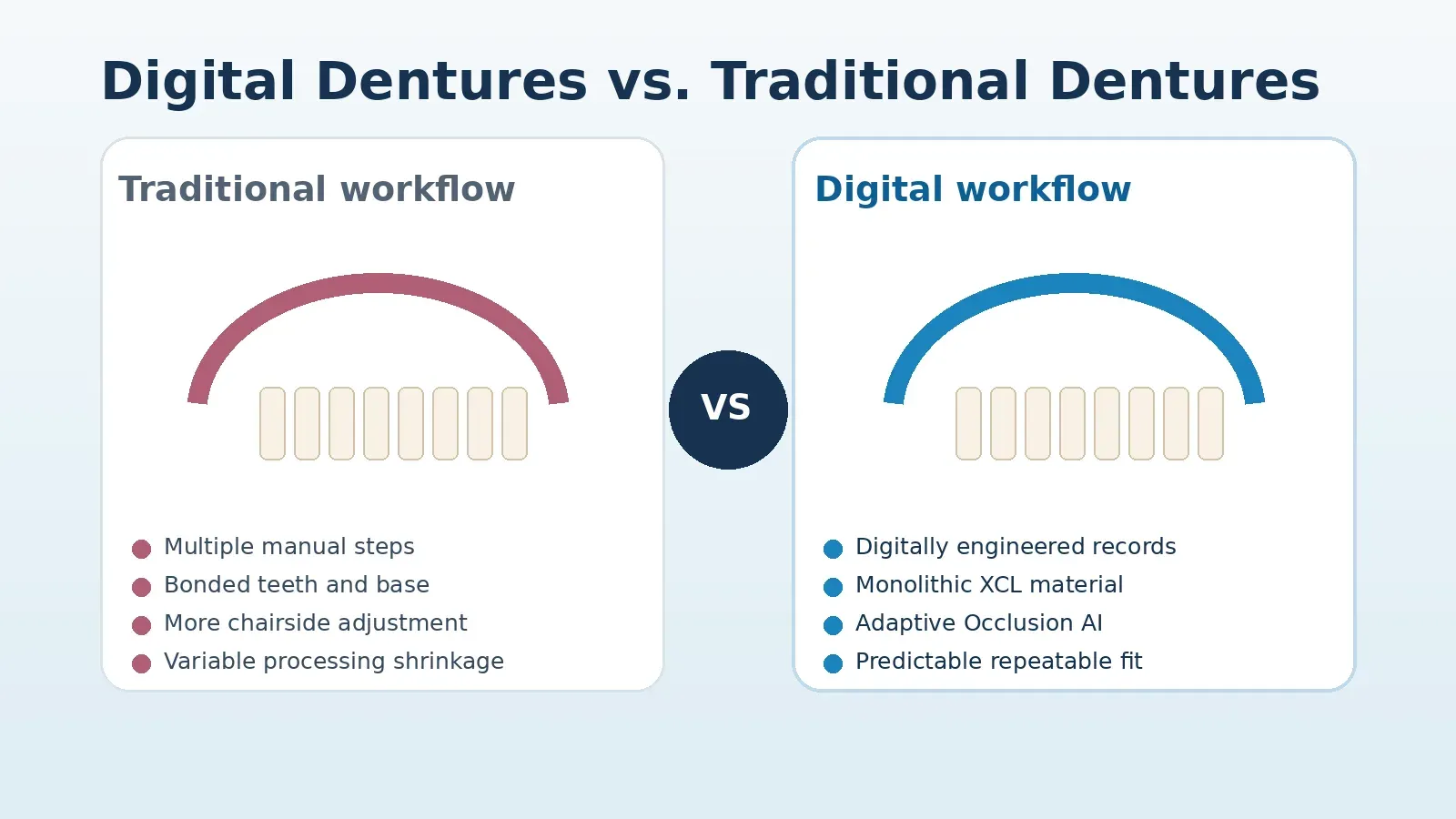
Conventional and fully digital dentures both require accurate records, appropriate design, and clinician verification. Their practical differences involve how records are captured and stored, how the prosthesis is fabricated, how design approvals are communicated, and how a replacement may be organized. A digital workflow changes the process, but it does not replace clinical judgment.
Both approaches depend on sound clinical records, prosthetic design, and an adjustment plan. Conventional complete dentures typically move through impression taking, jaw relation records, tooth arrangement, processing, and finishing as a sequence of physical steps. A fully digital pathway converts key records and design decisions into a reproducible file-based workflow.
| Consideration | Conventional pathway | Fully digital pathway |
|---|---|---|
| Workflow | Physical impressions, jaw relation records, setup, processing, finishing, and chairside verification are coordinated across clinical and laboratory stages. | Clinical records move into CAD design and digital manufacturing, with design review and production steps organized around a stored case file. |
| Records | Physical casts, impressions, photographs, and written records must be retained and transferred between appointments and providers. | Digital records and design files can be archived for reference, communication, and a future replacement workflow when the clinical situation supports it. |
| Material and fabrication | Base and tooth materials are processed through conventional laboratory steps, where handling and processing variables can affect consistency. | AvaDent dentures are milled from a single-piece, pre-shrunk XCL PMMA block. AvaDent documents a virtually porosity-free material and strength of up to eight times that of conventionally fabricated dentures. |
| Repeatability | Reproduction depends on the quality and availability of the original physical records and the laboratory's ability to recreate the prior setup. | Stored digital files can support repeatable design and manufacturing, subject to updated records, clinical review, and the patient's current anatomy. |
| Adjustment planning | Plan time for occlusal refinement, fit assessment, pressure-point relief, and follow-up as tissues and patient adaptation require. | Digital design review may help teams identify setup issues before fabrication, but try-in and delivery decisions still require clinician judgment and appropriate adjustment planning. |
The material distinction matters. A digital workflow is not simply a conventional denture made with different equipment, and the clinical result still depends on accurate records, appropriate design, and verification. Teams should evaluate the complete process rather than treating the word digital as a guarantee.
For practices assessing capacity, the most useful comparison is operational. Review how records are captured, who approves the design, when the team verifies esthetics and occlusion, how adjustments are communicated, and whether the file can be retrieved later. Review AvaDent's digital denture workflow efficiency implications alongside the clinical requirements of each case.
When do immediate dentures and try-ins fit the workflow?
Immediate dentures and try-ins serve different purposes. An immediate denture is coordinated with extraction timing and early healing. A try-in is a checkpoint for reviewing a proposed arrangement before final processing. Either may fit a case when its clinical purpose is clear, but neither stage should be added or omitted without considering tissue change, esthetics, records, and verification goals.
Immediate dentures and try-ins address different moments in treatment, even though both can appear in the same case plan. An immediate denture is a transitional appliance coordinated with extraction timing. It may help maintain an interim appearance while oral tissues heal and the clinician evaluates how the edentulous anatomy changes. It should therefore be planned as part of a staged pathway, not automatically treated as the definitive prosthesis.
A try-in is a verification stage before final processing. At this appointment, the clinician and patient can review tooth position, midline, lip support, phonetics, esthetics, and occlusal relationships while changes remain practical to make. The try-in connects records and design decisions to the finished appliance.
Sequence appointments around clinical milestones
Appointment sequencing depends on the extraction plan, records available, tissue conditions, and the level of verification needed. The team may capture diagnostic information first, coordinate the immediate appliance for delivery around extraction, and then schedule follow-up visits for fit, comfort, tissue assessment, and adjustment. If a definitive denture is being designed concurrently, place the try-in where it can meaningfully test the proposed tooth arrangement and occlusion before processing.
AvaDent documents both reference techniques and digital or analog workflows, but those examples should not be treated as universal protocols. The appropriate sequence is the one that gives the clinician reliable records and enough opportunity to review the design without compressing decisions that require clinical judgment.
Make the review record-based and communicative
Before the try-in, define what the team will verify and how feedback will be captured. Record the approved tooth shade and mold, midline, incisal display, phonetic observations, occlusal scheme, and requested changes. Use photographs or other practice-approved records when they improve communication between the clinician, patient, and laboratory. Review AvaDent's digital denture try-in process for related workflow considerations.
What are the tradeoffs of overdentures?
Overdentures combine removable access with retention from retained roots or implant-related attachments. That combination can support a different maintenance and hygiene plan than a tissue-supported denture, but it also adds attachment, restorative-space, records, and service requirements. The clinician should evaluate the entire pathway, not the attachment in isolation.
Removable overdentures occupy a middle ground between conventional complete dentures and fixed full-arch prosthetics. They may use retained roots or implant-related attachments to improve retention and support, while preserving the ability to remove the prosthesis for cleaning and professional maintenance. That combination can be useful, but it adds planning requirements that should be evaluated before the design is finalized.
Retention comes with attachment planning
The principal advantage is controlled retention. A clinician can assess anatomy, available support, restorative space, occlusal scheme, dexterity, and expectations before selecting an attachment concept. The attachment is not an isolated laboratory feature. Its position, path of removal, housings, resiliency, and access for future service all affect the clinical workflow.
Attachment selection should therefore be coordinated between the clinician and laboratory. AvaDent's overdenture attachment systems guide provides a deeper review of technical considerations. The appropriate choice remains case-specific rather than universal.
Removability improves access but creates duties
Unlike a fixed prosthesis, an overdenture can be removed so the patient and care team can access tissue-bearing surfaces and attachment components. That access can support hygiene instruction and routine evaluation. It also places responsibility on the patient to remove, rinse, and clean the prosthesis as directed. Attachments and housings are serviceable components, so wear, loss of retention, damaged parts, tissue changes, or altered fit may require evaluation and intervention.
Talk with AvaDent about your practice's denture workflow
When should clinicians evaluate fixed full-arch options?
Fixed full-arch options require coordinated implant, restorative, framework, material, hygiene-access, and maintenance planning. They are not simply more retentive removable dentures. Before selecting this pathway, the restorative team should confirm the diagnostic records, responsibilities, verification points, access requirements, and long-term service model for the individual case.
Fixed full-arch treatment deserves consideration when the restorative plan, implant strategy, and maintenance model can be designed as one coordinated workflow. The clinician must first determine whether implant placement is appropriate, then establish the records and restorative parameters needed to guide the prosthesis.
Start with implant and restorative planning
Evaluation should begin with the implant plan, including implant position, restorative space, occlusion, phonetics, esthetics, and the intended path of insertion or screw access. The restorative team should review relevant diagnostic records before committing to a framework design.
Depending on the case and established practice protocol, records may include photographs, scans or impressions, jaw relation records, occlusal information, diagnostic tooth position, and implant data. The objective is to give the design team enough information to evaluate tooth position, contours, hygiene space, and restorative clearance before fabrication.
Compare fixed and removable maintenance requirements
A fixed prosthesis changes the maintenance conversation. A removable complete denture can be taken out for cleaning and can be relined or adjusted through a familiar service pathway. A fixed full-arch prosthesis remains in place between professional appointments, so the plan should address home hygiene, professional debridement, component inspection, and future repairs. Hygiene access is a design requirement, not a finishing detail.
Make the framework and material decision explicit
Framework design and material selection should follow the implant plan, available space, occlusal demands, esthetic goals, and maintenance strategy. AvaMax is a titanium and high-density PMMA hybrid. It is not a generic monolithic denture, and the distinction matters when the team reviews framework behavior, restorative contours, repair expectations, and laboratory communication. See AvaDent's fixed full-arch prosthetic options for additional product-pathway context.
How should a practice evaluate a digital denture partner?
A digital denture partner should explain how the practice submits records, reviews designs, documents approvals, manages revisions, verifies production, stores files, and handles support after delivery. The strongest evaluation is operational and clinical at the same time. It asks whether the partner makes each handoff visible and repeatable without taking judgment away from the clinician.
A digital workflow is only as dependable as the handoffs that support it. Before selecting a laboratory or manufacturer, evaluate the complete path from records to delivery, not just the milling or printing method.
- Confirm the records checklist: Ask which photographs, scans or impressions, jaw relation records, occlusal information, implant data, and clinical notes are required.
- Define design-review checkpoints: Establish who reviews tooth position, midline, incisal display, phonetics, occlusion, contours, and esthetic references.
- Make fabrication and materials transparent: Ask whether the case is milled, printed, or processed conventionally, and what that means for the base, teeth, framework, repair pathway, and maintenance.
- Review quality controls and communication: Clarify how the partner checks the fit, occlusion, surface finish, and final records, and who communicates when information is missing.
- Plan for replacement and support: Confirm how digital files are stored, who can retrieve them, and what information is needed for a repair, remake, or replacement.
Teams can also review the digital fabrication techniques comparison and the AvaMax implant-supported denture guide when a titanium and PMMA pathway is relevant. Final selection remains a clinician-led decision.
How do full denture solutions support a repeatable selection protocol?
A repeatable protocol standardizes the questions a team asks without forcing every case into the same prosthesis. It should document the clinical objective, retention plan, records, verification stages, material questions, maintenance expectations, and approval owners. That decision trail helps the clinician, laboratory, and future care team coordinate changes responsibly.
A repeatable protocol should standardize the questions a team asks, not force every case into the same treatment pathway. Begin with a structured case conference that includes the restorative dentist, prosthodontist when involved, laboratory partner, and relevant surgical team. Review anatomy, the extraction plan, retention requirements, esthetic priorities, phonetic concerns, timeline, tolerance for appointments and adjustments, and maintenance capacity.
Document the reason for the pathway
Record the selected pathway and the alternatives considered. The note should explain why the case is proceeding with a conventional complete denture, a digital workflow, an immediate appliance, an overdenture, or a fixed full-arch option. Include the records used for the decision and any agreed esthetic references. This creates a clinical reference for the laboratory and prevents a technology choice from becoming the protocol itself.
Build checkpoints into the handoff
Set explicit coordination points between the practice, restorative team, and laboratory before fabrication begins. Confirm who owns record verification, design approval, try-in feedback, and changes after delivery. At the try-in, evaluate esthetics, phonetics, occlusion, tooth position, and the patient's understanding of the planned result before authorizing the final prosthesis.
- Define the clinical objective and retention requirement.
- Collect and review the records needed for design.
- Choose the appropriate verification stage, including a try-in when indicated.
- Confirm material, construction, timeline, and maintenance requirements.
- Approve the design and document the final handoff.
- Schedule delivery follow-up and record any adjustments or service needs.
Connect with AvaDent about your practice workflow
Frequently Asked Questions
How should a clinician choose among full denture solutions?
Start with the clinical requirements, not the fabrication label. Review anatomy, retention needs, extraction timing, records, esthetic and occlusal verification, adjustment tolerance, maintenance expectations, and the practice's laboratory workflow. The appropriate pathway may be conventional, digital, immediate, try-in, overdenture, or fixed full-arch, depending on the case.
When is a try-in stage worth including?
A try-in is useful when the team needs to verify tooth position, esthetics, phonetics, or occlusion before final processing. It is a verification stage rather than a separate final prosthesis category. The value is greatest when those factors are difficult to confirm from records alone or when multiple stakeholders need an intentional design review.
What should teams assess before selecting an overdenture or fixed full-arch option?
Assess implant or attachment planning, available support, retention and hygiene requirements, removability, framework and material choices, and the patient's ability to maintain the prosthesis. The restorative decision should follow clinical evaluation and should include a realistic plan for professional maintenance, component service, and future repairs.
How can a digital workflow support repeatable denture care?
Digital records and design files can support consistent communication, stored reference data, and a more repeatable manufacturing pathway. They may also simplify replacement planning when the original design remains available. Digital technology should support clinical judgment, not replace verification, because each case still requires current records and clinician review.
What follow-up should be planned after delivery?
Plan follow-up around fit, tissue health, occlusion, patient adaptation, hygiene, and any required adjustments. Removable prostheses need careful handling and cleaning instructions. Overdentures and fixed full-arch options also require component, implant, framework, and hygiene-access reviews appropriate to the case.
Get started with a denture workflow discussion
Choosing among conventional, digital, immediate, try-in, overdenture, and fixed full-arch pathways depends on your clinical requirements and practice workflow. A focused conversation can help your team compare records, design checkpoints, materials, and support considerations before selecting a direction.